What is Data Enrichment: A Guide to Working Smarter
Curious what is data enrichment? Learn how adding context to your datasets boosts insights and drives smarter decisions.
You’ve been there: staring at a spreadsheet full of gaps. A list of company names, but no industries. A column of emails, but no job titles. And you know what comes next—the manual, soul-crushing grind of filling in the blanks. That hunt through LinkedIn and company websites is the traditional, slow-motion version of data enrichment.
But as you know, the tools and data sources available are progressing rapidly. There are smarter ways to tackle this.
Going Beyond the Spreadsheet
Modern data enrichment isn't some abstract concept; it's an automated, intelligent solution to a problem you already solve manually. Instead of treating your data as a static list, enrichment transforms each row into a dynamic, multi-layered profile.
Think of it like this: a plain email address is a single data point. After enrichment, it becomes a story, revealing the person's job title, their company's size, its industry, and even the software it uses.
The real power here is the context it adds. It connects isolated dots, revealing patterns and opportunities that are invisible in a raw spreadsheet. For junior analysts and specialists, this means shifting your time from tedious data grunt work to the high-value strategic thinking you were hired for. The goal is to make every row in your dataset work harder for you.
Here's what that looks like in practice:
- Completing the Picture: Filling in critical missing details like job titles, company revenue, or employee count needed to qualify a lead or screen an investment.
- Improving Accuracy: Correcting and validating existing information, ensuring your outreach and analysis are built on a solid foundation. You can dive deeper into this by checking out our data cleaning best practices guide.
- Adding Contextual Layers: Appending firmographic data (like company size), demographic data (like location), or technographic data (like what software a company uses) to get a much richer understanding of each record.
From Raw Data to Actionable Intelligence
This table shows how this transformation plays out, turning simple lists into strategic assets.
| Data Point | Example of Raw Data | Example of Enriched Data |
|---|---|---|
| Email Address | jane.doe@acme.com | Jane Doe, VP of Marketing @ Acme Corp. |
| Company Name | InnovateTech | InnovateTech, SaaS, 150 employees, $20M revenue |
| Website | example.com | example.com, uses HubSpot, Salesforce, Stripe |
Enrichment turns basic inputs into a comprehensive profile you can use for segmentation, personalization, or scoring.
So, what is data enrichment? It’s the bridge between having data and having intelligence. It’s the automated process that turns a basic spreadsheet into a strategic weapon, giving marketing, sales, and investment teams the precision they need to make smarter, faster decisions.
How Data Enrichment Methods Have Evolved
The core idea of adding context to data isn't new, but the tools and techniques have changed dramatically. You're likely familiar with the traditional ways of gathering more information, but the jump from static lists to intelligent, automated systems represents a massive leap in efficiency and accuracy.
This shift directly impacts how quickly you can get from a raw spreadsheet to a meaningful analysis.
This process isn’t a complex black box; it’s a clear journey of transformation that makes your raw inputs exponentially more valuable.
The Age of Third-Party Data Appends
The original method was the third-party data append. You'd send your list of leads or companies to a data broker. They'd match it against their massive, static database and return a file with the missing fields filled in.
While straightforward, this approach has a huge, unavoidable downside: data decay. People change jobs, companies get acquired, and information goes stale. Fast. Studies show B2B data can decay at a rate of over 2% per month, which means a significant chunk of a purchased list could be useless within a year.
The Rise of Live Web Augmentation
To combat stale data, teams turned to live web augmentation—what many know as web scraping. Instead of buying a pre-packaged database, this method involves building tools to pull fresh information directly from public websites or professional networks in real time.
This was a major step up for data freshness, but it also introduced a new set of headaches.
- Consistency: Custom scrapers are notoriously brittle. A minor website update can break them, leading to inconsistent or incomplete data pulls.
- Scale: Manually building and maintaining scrapers for hundreds of different sources is a massive technical project, often beyond the scope of analysis teams.
- Maintenance: Keeping these tools running requires constant engineering resources, which pulls focus from the actual work of analysis.
Today's AI-Driven Enrichment
Now, we’re in the era of AI-driven enrichment. This modern approach combines the best of both worlds and adds a layer of intelligence. AI platforms can interpret unstructured data, understand context, and intelligently source information from the live web on demand.
Instead of just matching records, AI can understand a prompt like "Find the annual revenue and key decision-makers for each company on this list" and execute it across thousands of rows with remarkable consistency.
This is what turns data enrichment from a clunky, one-off project into a dynamic, repeatable workflow. You get the real-time accuracy of web scraping without the technical overhead, and a level of scale that static lists could never touch. For analysts, this means getting reliable, deep insights becomes a simple, prompt-driven task—not a month-long data-cleaning nightmare.
Connecting Data Enrichment to Smarter Decisions
<iframe width="100%" style="aspect-ratio: 16 / 9;" src="https://www.youtube.com/embed/byQK35cb4Qo" frameborder="0" allow="autoplay; encrypted-media" allowfullscreen></iframe>Enriched data isn't just about tidying up a spreadsheet; it’s about building a competitive edge. This is where the prep work pays off and turns into tangible business impact. It’s the link between having a pile of raw information and having the kind of intelligence that moves the needle.
Suddenly, you can stop guessing and start knowing. Your data becomes the fuel for more confident, strategic work.
Moving from Guesswork to Strategy
High-quality, complete data allows your team to operate with precision instead of running on assumptions. With every row you enrich, you add a layer of certainty that sharpens strategy and improves results, no matter the project.
For a demand-generation specialist, this means moving beyond generic email blasts. Using enriched firmographic and technographic data, you can build hyper-targeted audiences and craft campaigns that speak directly to a prospect’s specific tech stack and pain points.
Enriched data is the difference between knowing a lead's email and understanding their potential. It transforms a simple contact list into a strategic map of your ideal customer profile.
For a VC analyst screening hundreds of potential investments, manually researching each company’s funding history or employee growth takes weeks. With enriched data, you can run an entire list against a precise investment thesis in minutes, automatically surfacing the best-fit opportunities so you can focus your energy on the deeper due diligence that matters.
Fueling Data-Driven Growth
The focus on data-driven strategy is more than a trend; it's a fundamental shift. The global market for data enrichment solutions was valued at around USD 2.57 billion in 2024 and is expected to blow past USD 4.5 billion by 2030. It's clear why: nearly 68% of companies now prioritize data-driven strategies because better inputs lead to better outputs. You can dig into these data enrichment market trends for a closer look.
This makes data enrichment a non-negotiable for any team that wants to make confident decisions.
When your CRM is full of accurate job titles and company sizes, your sales team can score leads with deadly accuracy. When your market research is built on verified demographic and sentiment data, your insights are actually reliable. Our guide on AI for data analysis shows how this all comes together in practice.
Ultimately, investing in enrichment is about building a powerful, reliable engine for decision-making. It ensures every analysis, campaign, and investment thesis starts from a solid foundation of complete, accurate information. That’s how you and your team move faster and with more confidence.
Data Enrichment in the Real World
Theory is one thing, but the real test is how data enrichment performs on the ground, solving the tedious problems that analysts face daily.
Let’s look at how this works in practice for tasks you’re already doing, transforming frustrating manual work into a fast, repeatable, and scalable process. The difference isn't just about speed; it's about unlocking a deeper level of analysis that was previously out of reach.
Transforming a Lead List for Demand Generation
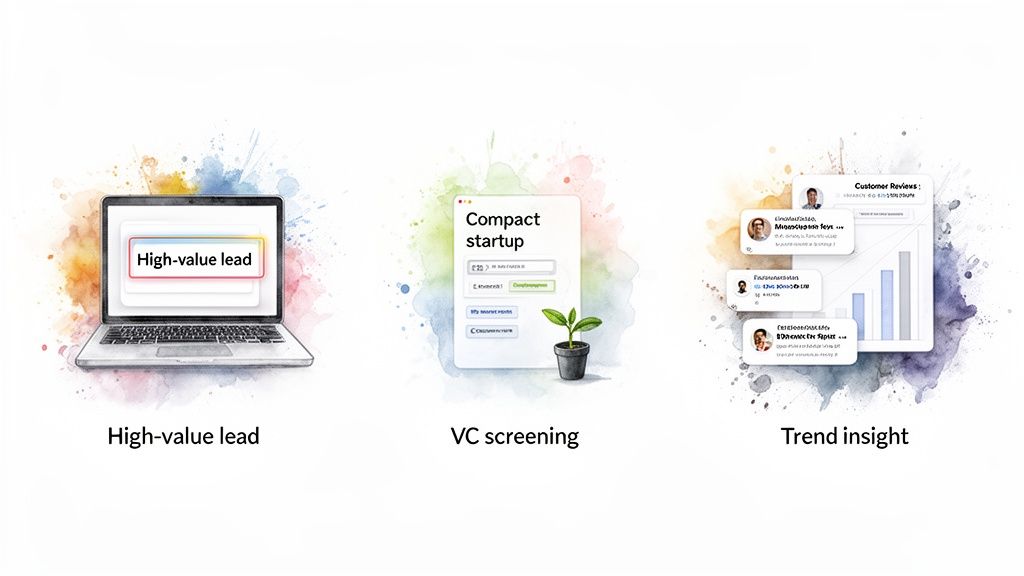
Imagine you’re a demand-gen specialist handed a list of 5,000 emails from a recent event. Right now, it’s just a list of emails. To make it useful, you need to know who these people are, where they work, and if they fit your ideal customer profile (ICP).
-
The Traditional Way: You and your team face days, maybe weeks, of manually plugging each email into LinkedIn or a search engine. You copy and paste job titles, company names, and employee counts, knowing the data is getting staler by the minute. The process is slow, inconsistent, and a poor use of your team's time.
-
The AI-Driven Way: You upload the entire CSV to an enrichment platform. You write a simple, plain-English prompt like, "For each email, find the person's full name, job title, company name, industry, and employee count." The system gets to work. Within minutes, you have a complete, consistently formatted dataset ready for segmentation and targeted outreach.
This shift lets you move from generic email blasts to hyper-personalized campaigns based on role, industry, and company size—driving real engagement.
Screening Hundreds of Startups for VCs
For a venture capital analyst, deal flow is a firehose. You might get a list of 300 startups to screen against your firm’s specific investment thesis—say, B2B SaaS companies with 10-50 employees that recently raised a Seed round and are using specific cloud technologies.
The core challenge for analysts isn't a lack of data, but the overwhelming effort required to structure that data in a way that aligns perfectly with a unique investment thesis.
Manually digging through PitchBook, Crunchbase, and individual company websites for each of those 300 startups is a monumental task. It’s a bottleneck that slows down deal screening and creates the risk of a great opportunity slipping through the cracks.
With an AI-powered approach, the analyst can upload their list and apply a prompt that perfectly mirrors their thesis. The platform can augment the initial data with live web searches to find funding rounds, estimate employee growth, and even identify key technologies from each company’s website. The result is a prioritized list of the top 10% of startups that are a perfect match, delivered in a fraction of the time.
Analyzing Customer Sentiment for Market Research
Now, let's put ourselves in the shoes of a market researcher. They've been tasked with analyzing 10,000 unstructured customer reviews scraped from various websites. The goal is to identify common themes, gauge overall sentiment (positive, negative, neutral), and spot emerging trends.
-
The Traditional Way: Manually reading and tagging each review isn't just impractical; it's impossible to do consistently. The risk of human bias is high, and the sheer volume means you can only analyze a small sample, almost guaranteeing you'll miss the bigger picture.
-
The AI-Driven Way: By uploading the raw reviews, a researcher can use a prompt to automatically classify every single entry. For instance: "Analyze each review to determine sentiment (Positive, Negative, Neutral), extract key themes mentioned (e.g., 'Pricing,' 'Customer Support,' 'Feature Request'), and summarize the core complaint or compliment."
The system applies this logic uniformly across all 10,000 reviews, producing a structured dataset that reveals quantifiable insights. Suddenly, you can see that 35% of negative reviews mention "slow response times," giving the product team a clear, data-backed priority to tackle. This is what data enrichment is all about—turning chaotic, raw text into clear, strategic direction.
How AI Is Automating the Enrichment Process
The old way of enriching data was a grind of endless VLOOKUPs, tedious Googling, and inconsistent copy-pasting. That manual approach is finally being replaced by something much smarter.
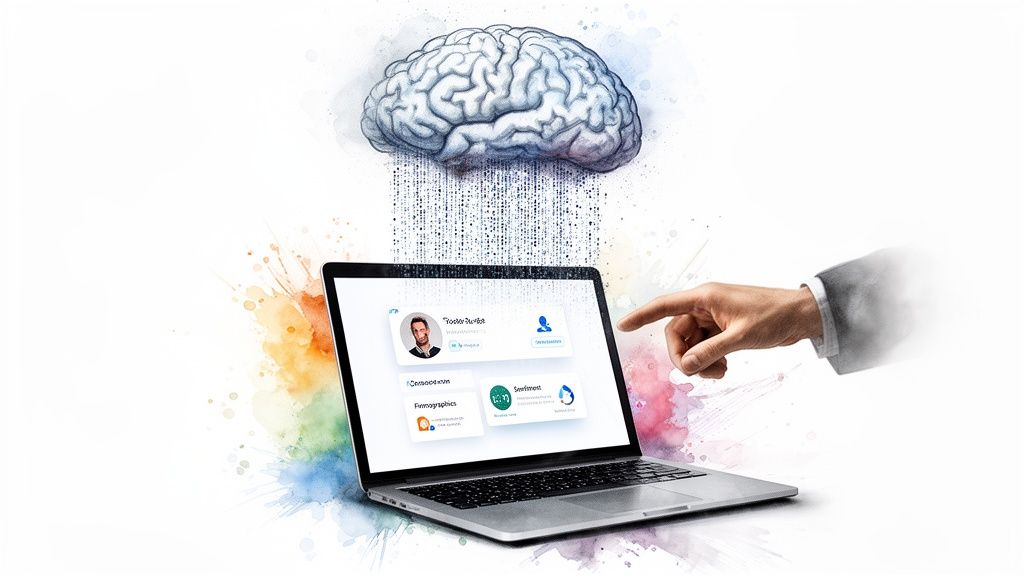
Modern enrichment platforms are now built on artificial intelligence, specifically Large Language Models (LLMs), and they're completely changing how analysts get work done. Instead of just matching records against a static database, AI can interpret context and understand plain-English instructions. This is the tech that ends the nightmare of manual data work for good.
From Manual Tasks to Intelligent Prompts
The biggest shift is moving away from rigid, rule-based tasks toward flexible, prompt-driven workflows. You no longer need to know how to code or build complex scrapers to pull the information you need.
You just tell the system what you want in natural language. An analyst can hand over a list of company domains and ask an AI platform to: "For each domain, find the company's estimated annual revenue, identify its key competitors, and summarize its primary business model."
The AI then intelligently finds this information from the live web, structures it, and hands back a clean, consistent dataset. This makes sophisticated analysis accessible to everyone on the team, not just the technical experts.
AI-driven enrichment isn’t just about speed; it's about achieving a level of scale and consistency that is impossible to replicate manually. It applies the exact same logic to row one and row ten thousand.
This shift is a huge driver in the data enrichment market. For example, marketing teams using AI-enriched customer profiles have seen 22% higher conversion rates. At the same time, cloud-based tools now make up 72% of the market because they're far cheaper to run than old on-premise solutions, putting this tech within reach for teams of any size. You can read more about the growth of the data enrichment market.
The Power of Batch Processing and Augmentation
The real game-changer for analysts is combining AI with batch processing. This lets you apply a single, powerful prompt across thousands of rows at once. It's especially critical for jobs like market research, where consistency is everything. Our guide on AI-powered market research digs into these workflows in more detail.
This automated process breaks a huge task down into simple, repeatable steps:
- Prompt Application: Your instruction is applied to each individual row in your spreadsheet.
- Web Augmentation: The AI performs live web searches to find missing info or validate data points for that specific row.
- Structured Output: The results are formatted consistently and delivered right back into your dataset, ready for you to use.
This automated, batch-driven approach finally lets analysts stop spending their time on low-value data collection and start focusing on the high-impact insights that actually drive the business forward.
Common Questions About Data Enrichment
Moving from manual grunt work to a more automated approach can feel like a big shift. It's normal to have practical questions as you explore data enrichment tools. Here are some straightforward answers to help you understand why an AI-driven approach is a smarter way to work.
How Much Data Do I Actually Need to Start?
You really don't need a massive database to see the payoff. In fact, starting small is often the best approach. Even enriching a focused list of just 50-100 high-value leads or target accounts can provide immediate, powerful insights for your next sales or marketing push.
The key is to start with a specific, high-stakes problem you want to solve right now—like qualifying inbound leads better or doing a quick screen on a handful of investment targets. This lets you dial in your workflow and see a real return on your effort before scaling up to larger datasets.
Is Data Enrichment a One-and-Done Thing or an Ongoing Process?
While a one-time data cleanup is incredibly valuable, the real pros treat data enrichment as a continuous process. Think about it: business data goes stale fast. People switch jobs, companies pivot, and new information pops up constantly.
Think of data enrichment less like a single deep clean and more like routine maintenance for your data. Regular refreshes keep your insights sharp and ensure your decisions are always based on what's true today, not last quarter.
Modern tools make this simple. You can save and rerun your enrichment jobs, turning what used to be a huge project into a simple, repeatable task you barely have to think about.
How Secure Is My Data with an Enrichment Platform?
This is a critical question. Any reputable AI enrichment platform is built from the ground up with data privacy and security in mind. When you're evaluating a tool, look for clear, easy-to-find policies on data handling, encryption, and compliance with standards like GDPR and CCPA.
Your data should only ever be processed securely. It should never be used to train models or be mixed with anyone else's information. The entire point of these platforms is to augment your data for your use only, ensuring your proprietary info stays confidential and secure from start to finish.
Ready to stop the manual grind and start working smarter? Row Sherpa provides the AI-powered tools to enrich, score, and analyze your data at scale. Launch your first enrichment job for free.