The 12 Best AI Tools for Market Research in 2026
Discover the best AI tools for market research. A curated list for junior analysts to automate tasks, enrich data, and work smarter. Explore our 2026 picks.
The days of manually sifting through endless spreadsheets, survey responses, and industry reports are numbered. As a market research or VC analyst, you already know the grind of data collection and synthesis; the challenge isn't understanding the work, it's about executing it faster and with greater precision. This is where artificial intelligence transforms the workflow from a laborious, time-intensive process into a strategic, insight-driven operation. The right tools don't just speed up tasks, they unlock deeper layers of understanding from the data you already have, and help you find new data sources you might have missed.
This guide is designed for junior analysts, demand-gen specialists, and VC analysts looking to navigate and select from the best AI tools for market research available today. We’re moving beyond generic feature lists to provide a practical, curated resource. Our goal is to help you identify which platforms will most effectively augment your current processes, whether you’re enriching CRM data, analyzing competitive landscapes, or tracking market sentiment. Think of it as an upgrade for your entire market research stack.
Here, you'll find a detailed breakdown of 12 essential tools, from data enrichment platforms like Row Sherpa to audience intelligence engines like SparkToro. Each entry includes:
- A concise summary of its core function.
- Strengths, weaknesses, and ideal use-cases.
- Clear screenshots and direct links to get started.
- Actionable insights for integrating these tools into your daily tasks.
We’ve done the heavy lifting to help you find the right technology to work smarter, so you can focus on what truly matters: deriving actionable intelligence that drives decisions.
1. Row Sherpa
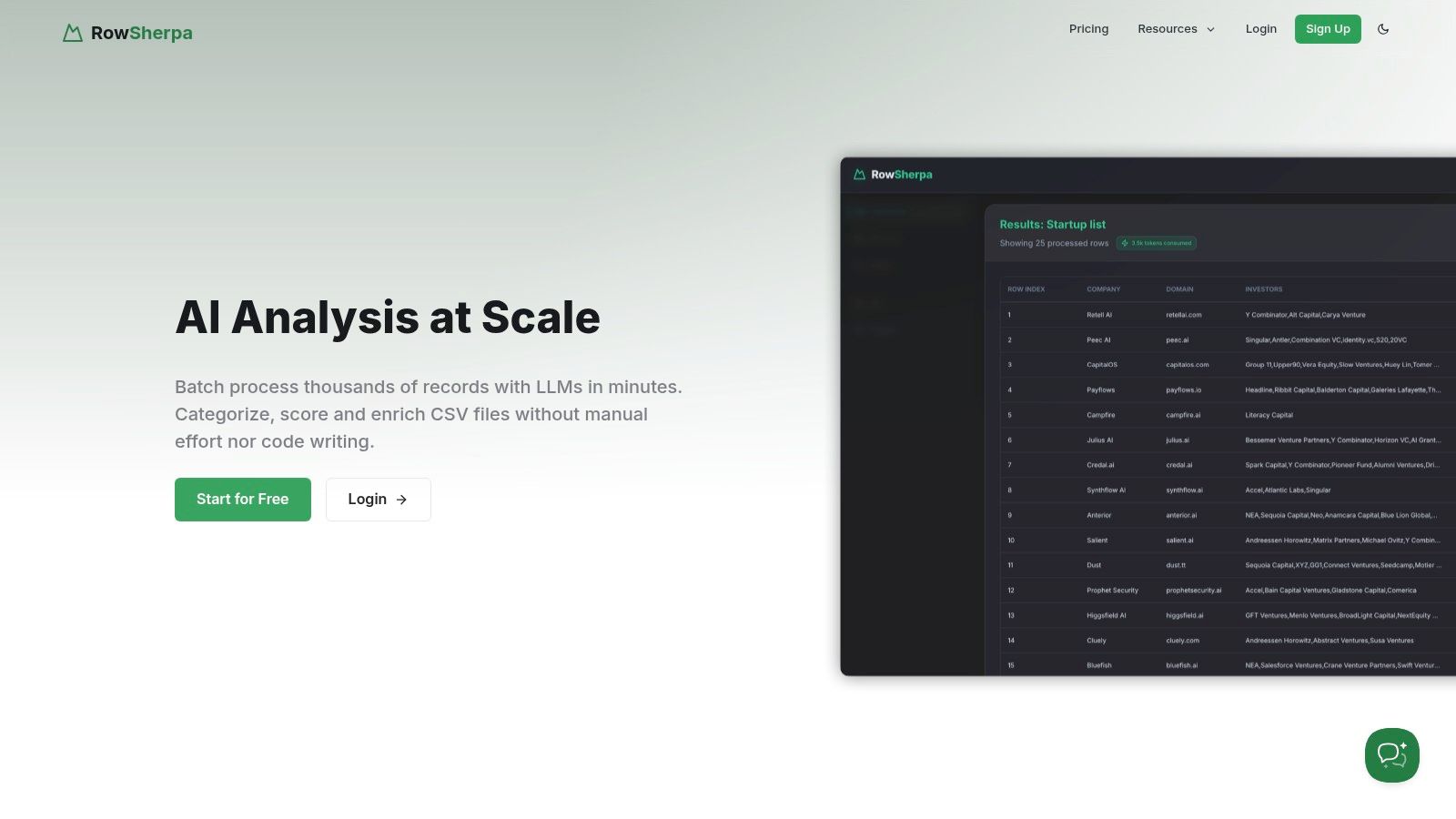
Row Sherpa stands out as a powerful, no-code platform designed to automate and scale the often tedious, row-by-row data processing tasks fundamental to market research. It excels at transforming unstructured or raw data from CSV files into structured, analysis-ready outputs, making it one of the best AI tools for market research analysts tasked with large-scale data enrichment and classification. Its core strength lies in applying a single, validated AI prompt consistently across thousands of rows, which eliminates the variability of manual analysis and the unpredictability of chat-style AI tools.
This approach ensures that whether you're extracting competitor features from a list of websites, classifying customer feedback for sentiment, or enriching a prospect list with firmographic data, the output is always reliable and formatted correctly as JSON or CSV. This makes downstream integration into CRMs, databases, or analytics platforms seamless. For junior analysts, this tool acts as a force multiplier, turning multi-day manual projects into asynchronous jobs that run in minutes.
Core Features & Use Cases
Row Sherpa is built for repeatable data workflows. Its optional live web search feature is particularly potent, allowing the AI to enrich each row with fresh, real-time context before processing.
- Batch Data Enrichment: Augment company lists with current firmographic data, screen investment opportunities against a custom thesis, or enrich CRM contacts with relevant social or news context.
- Entity Extraction & Taxonomy: Systematically extract key entities like product names, technologies used, or key personnel from unstructured text across thousands of sources.
- Sentiment & Intent Analysis: Process large volumes of customer reviews, survey responses, or social media comments to consistently categorize sentiment and user intent at scale. You can find detailed guides on their site for implementing AI-powered market research workflows.
Pricing & Access
Row Sherpa operates on a transparent, usage-based model with clear tiers.
| Plan | Rows / Job | Web Search Rows | Key Features |
|---|---|---|---|
| Free | 25 | 10 | Basic processing, 1 saved prompt |
| Starter | 2,500 | 250 | API access, 5 saved prompts |
| Premium | 10,000 | 1,000 | Higher limits, 25 saved prompts |
| Pro | 50,000 | 5,000 | Highest limits, team features |
Strengths & Limitations
Pros:
- Scale and Speed: Asynchronous jobs process thousands of rows in minutes without requiring any code.
- Predictable Outputs: Enforces a consistent JSON/CSV schema for reliable, structured results.
- API-First Design: Every UI action is backed by a public API, enabling full programmatic automation.
Cons:
- Plan Constraints: Large-scale projects may hit row, web-search, or token limits on lower-tier plans.
- Data Retention Policy: Uploaded files and results are automatically deleted after 30 days, which may not suit teams needing long-term archival or specific compliance.
2. G2
While not an AI tool itself, G2 is an indispensable meta-tool for any analyst or operations specialist tasked with evaluating the landscape of best AI tools for market research. It serves as the largest peer-review software marketplace, providing a structured way to discover, compare, and shortlist vendors across critical categories like social listening, competitive intelligence, and qualitative AI analysis.
G2’s primary value lies in its aggregated, verified user reviews. These reviews offer authentic, ground-level insights into a tool's actual performance, usability, and implementation hurdles, moving beyond polished marketing copy. This is crucial for junior analysts who need to build a strong business case for new software investments based on real-world evidence.
Core Features & Use Case
- Category Grid Reports: Visualize market leaders, contenders, and niche players in a four-quadrant format based on user satisfaction and market presence. This is the fastest way to create a vendor shortlist.
- Verified User Reviews: Filter reviews by company size, industry, and user role to find feedback from peers facing similar challenges.
- Feature Checklists & Comparisons: Directly compare up to four vendors side-by-side on specific features, pricing models, and integrations.
Practical Tip: Use G2 to validate the claims made on a vendor’s website. If a tool boasts "seamless integration," check the G2 implementation reviews to see what real users experienced. This helps de-risk your procurement process significantly.
| Strengths | Weaknesses |
|---|---|
| Broad Vendor Coverage: Comprehensive listings across many AI niches. | Sponsorship Influence: Promoted listings can affect visibility. |
| Real-World Signals: Insights on usability and customer support. | Gated Content: Deeper reports may require creating an account. |
Website: https://www.g2.com
3. Capterra
Similar to G2, Capterra operates as a comprehensive software directory, acting as a crucial starting point for discovering the best AI tools for market research. As part of the Gartner Digital Markets family, it provides a structured and user-driven platform for analysts to create initial vendor shortlists based on peer experiences and feature-level comparisons. Its US-centric focus provides deep insights into tools popular in the North American market.
Capterra's value proposition for a junior analyst is its straightforward approach to tool discovery. Instead of relying solely on vendor marketing, you can leverage its extensive filter system and verified reviews to quickly identify potential AI solutions that meet specific criteria, like budget, deployment type, or essential features. This streamlines the otherwise time-consuming task of initial landscape mapping.
Core Features & Use Case
- Advanced Filtering: Narrow down software options by specific AI features, pricing models (e.g., subscription, free), and deployment types (e.g., cloud, on-premise).
- Vendor Snapshots: Access concise vendor pages that include user reviews, key features, pricing notes, and direct links to request demos.
- "Shortlist" Reports: Utilize Capterra’s methodology to generate reports comparing top-rated tools, which can serve as an objective foundation for your internal business case.
Practical Tip: Use Capterra’s filters to find tools that offer a free trial or a freemium plan. This allows you to conduct hands-on testing of several AI platforms with zero financial commitment, helping you build a more robust and evidence-based recommendation.
| Strengths | Weaknesses |
|---|---|
| Transparent Methodology: Clear about its review verification process. | Sponsored Placements: Vendor visibility can be influenced by ad spend. |
| Efficient Shortlisting: Excellent for quickly producing an initial list. | Less Depth: Provides less analytical depth than a full analyst report. |
Website: https://www.capterra.com/market-research-software/
4. GetApp
Like G2, GetApp is a software marketplace rather than a direct AI tool. It’s particularly valuable for small and mid-sized business (SMB) teams or junior analysts tasked with quickly finding accessible and often more affordable best AI tools for market research. As a sister site to Capterra, it specializes in helping buyers discover apps with specific functionality, like AI-powered analytics or automation.
GetApp’s strength lies in its ‘Category Leaders’ reports, which use a transparent, multi-criteria scoring system to rank vendors. This is ideal for analysts who need to build an initial vendor list without getting bogged down in enterprise-level reports, focusing instead on tools that are practical for smaller, more agile teams. The platform's strong focus on integrations also helps identify tools that will easily connect to an existing SMB tech stack.
Core Features & Use Case
- Category Leaders: See ranked leaderboards based on a clear scoring methodology covering user reviews, integrations, mobile app availability, and security.
- AI Feature Filters: Quickly narrow down searches to only include tools with specific AI capabilities, such as predictive analytics or natural language processing.
- Category Overviews: Get a high-level summary of the market research software category to speed up the shortlisting process from dozens of vendors to just three or four.
Practical Tip: Use GetApp's integration filters (e.g., Google Sheets, Salesforce) early in your search. This ensures any tool you evaluate will actually fit into your team’s existing workflows, saving significant time later on.
| Strengths | Weaknesses |
|---|---|
| North America-Focused: Eligibility criteria often favor US-based buyers. | Less In-Depth: Analysis is less comprehensive than full analyst reports. |
| Quick Overviews: Excellent for rapidly narrowing down candidate tools. | SMB Prioritization: May overlook powerful enterprise-grade solutions. |
Website: https://www.getapp.com/marketing-software/market-research/category-leaders/
5. Product Hunt
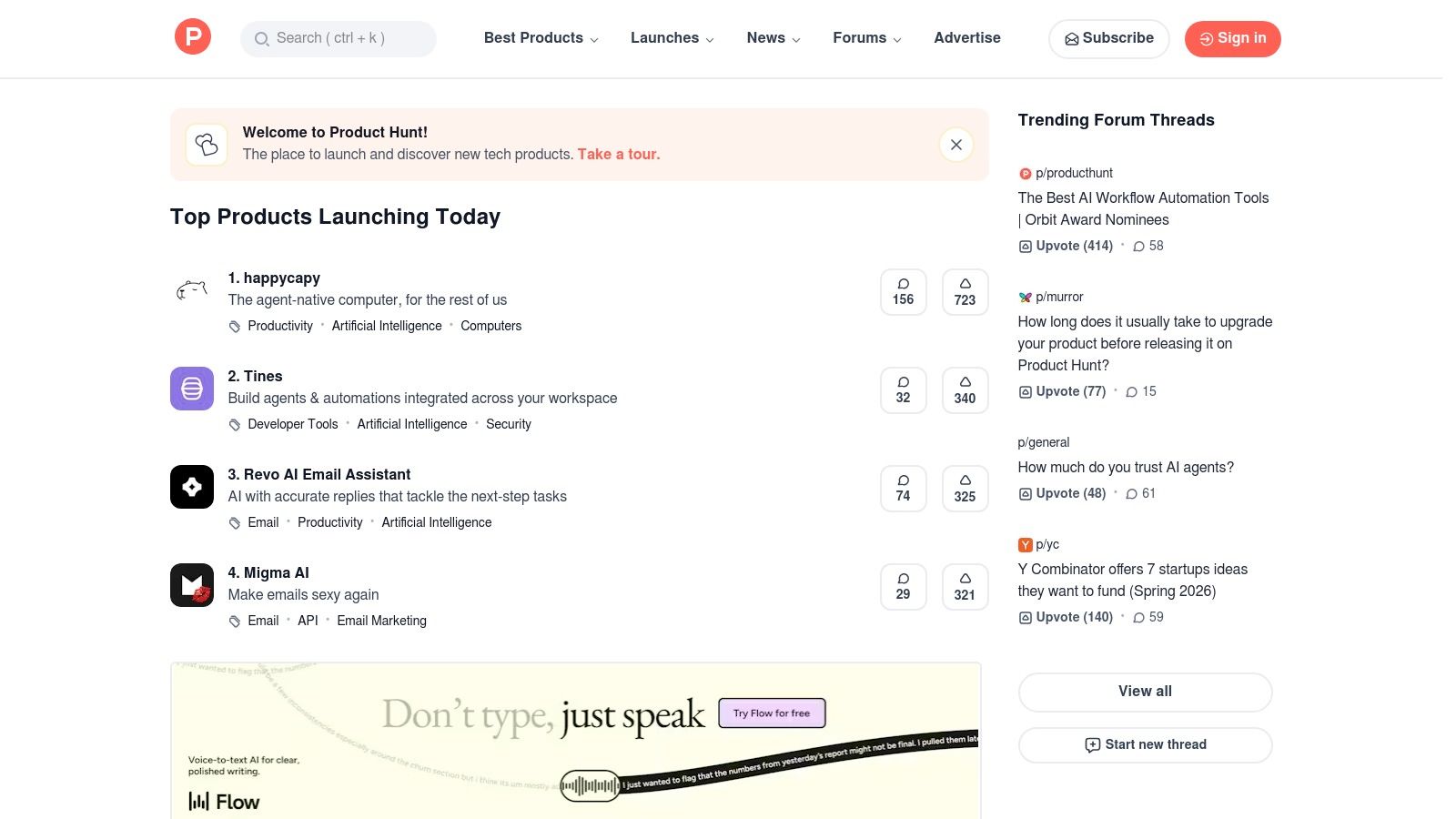
While not an AI tool itself, Product Hunt is an essential discovery platform for any analyst looking to stay ahead of the curve. It's where many of the best AI tools for market research make their debut, offering a real-time feed of emerging technologies, AI agents, and niche research assistants before they become mainstream. This makes it an invaluable resource for spotting innovative solutions that can augment an existing market research stack.
For junior analysts, Product Hunt provides a unique opportunity to identify experimental tools that solve hyper-specific problems. The platform’s value lies in its community-driven curation; the upvotes, comments, and discussions surrounding a new product launch offer immediate, unfiltered feedback on its potential utility, target audience, and initial user experience.
Core Features & Use Case
- Artificial Intelligence Topic Feeds: Filter daily launches to see only AI-powered tools, making it easy to track new market entrants in the research space.
- Curated Collections: Explore user-created lists like "AI Research Assistants" or "Data Analysis Tools" to find vetted products for specific workflows.
- Community Feedback & Launch Signals: Analyze comments and upvotes from early adopters to gauge a tool's viability and identify potential use cases that aren't mentioned in the marketing copy.
Practical Tip: Follow the "Artificial Intelligence" topic on Product Hunt and set up daily or weekly email digests. This creates a low-effort, high-signal channel for discovering new tools that could give your research process a competitive edge.
| Strengths | Weaknesses |
|---|---|
| Early Signal on New AI Products: Discover tools on day one of their launch. | Variable Product Quality: Many products are in beta or early stages. |
| Community-Driven Vetting: User reactions highlight genuine potential. | Requires Further Due Diligence: Tools often lack extensive case studies. |
Website: https://www.producthunt.com
6. Similarweb
Similarweb is a foundational digital intelligence platform that provides a macroscopic view of the competitive landscape. For market researchers, it is an essential tool for benchmarking digital performance, understanding traffic acquisition strategies, and analyzing audience behavior across any website or industry. It moves beyond simple traffic estimation, offering granular insights into which marketing channels drive success for competitors, making it one of the best AI tools for market research available for share-of-voice analysis.
Its power lies in transforming raw web traffic data into strategic competitive intelligence. A junior analyst can quickly size a market, identify emerging challengers, and understand the digital strategy of established leaders without needing complex data models. This allows teams to benchmark their own performance against the market and pinpoint opportunities for growth in specific channels or regions.
Core Features & Use Case
- Competitive Intelligence: Analyze any competitor’s website traffic, engagement metrics, and audience demographics to understand their digital footprint.
- Market & Channel Breakdowns: See precisely which marketing channels (e.g., Organic Search, Paid Search, Social, Direct) are driving traffic for competitors and identify their most effective acquisition strategies.
- Audience Demographics & Interests: Gain insights into the age, gender, location, and browsing interests of a website’s audience to refine targeting and messaging.
Practical Tip: Use Similarweb's "Top Referring Sites" feature to uncover partnership and affiliate marketing opportunities. If a key competitor is getting significant traffic from a specific publisher, that publisher might be a valuable partner for your own brand.
| Strengths | Weaknesses |
|---|---|
| Actionable Market Overviews: Provides clear, strategic insights for analysts. | Limited Historical Data: Lower-tier plans have restricted look-back periods. |
| Transparent Pricing: Several packages have publicly listed prices. | Advanced Modules Gated: Key features may require higher-tier subscriptions. |
Website: https://www.similarweb.com
7. AlphaSense
AlphaSense is an AI-powered market intelligence platform designed for deep, qualitative research. It excels at indexing and analyzing a vast universe of business documents, including SEC filings, earnings call transcripts, broker research, and expert interviews. For corporate strategy, M&A, and competitive intelligence teams, it stands out as one of the best AI tools for market research by turning unstructured text into a searchable, synthesizable asset.
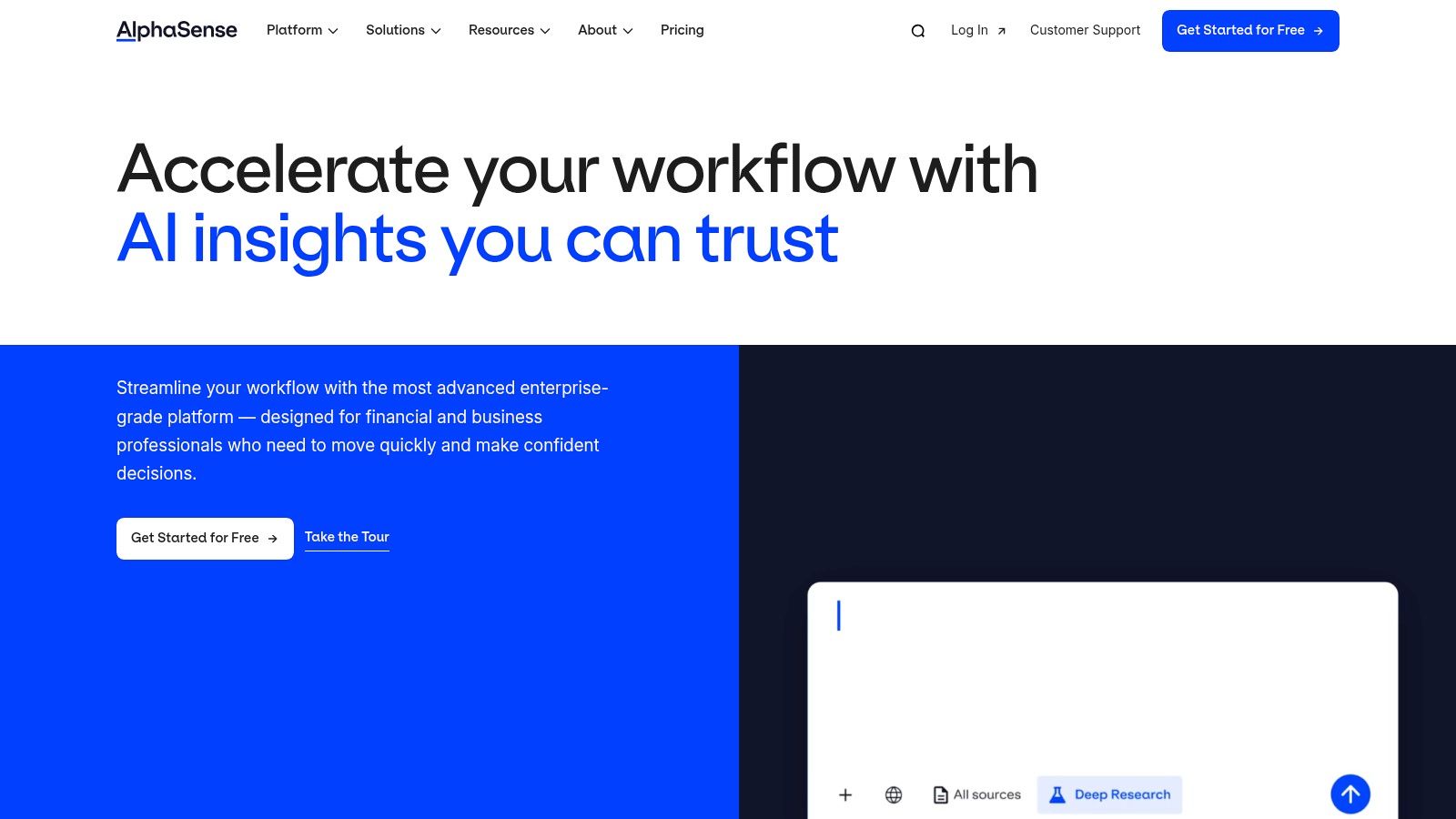
The platform’s core strength is its powerful, AI-driven search that understands natural language and financial terminology. Instead of just keyword matching, it identifies concepts and themes across millions of documents, allowing analysts to rapidly uncover insights that would otherwise require weeks of manual reading. This is particularly valuable for junior analysts tasked with building a comprehensive view of a market landscape or a competitor’s strategy.
Core Features & Use Case
- Smart Synonyms™ Technology: Automatically expands searches to include relevant keyword variations, ensuring no critical information is missed. Ideal for tracking themes like "supply chain disruption" or "AI investment."
- AI-Powered Summarization: Generates concise summaries of lengthy documents, such as earnings calls or research reports, to quickly grasp key takeaways.
- Expert Call Library: Provides searchable transcripts from thousands of interviews with industry experts, offering ground-level perspectives on niche topics.
Practical Tip: Use the "Alert" feature to monitor specific companies, topics, or industries. AlphaSense will automatically notify you of new filings, news, or transcript mentions, turning the platform into a proactive intelligence engine for your team.
| Strengths | Weaknesses |
|---|---|
| Deep Content Coverage: Unparalleled access to premium financial data. | Sales-Led Pricing: Pricing is not public and requires a sales demo. |
| Powerful AI Search & Summarization: Drastically reduces manual review. | Enterprise Focus: Positioned as a premium tool, less suited for small budgets. |
Website: https://www.alpha-sense.com
8. NIQ (NielsenIQ)
For analysts working in consumer packaged goods (CPG), NIQ represents the gold standard of retail scanner and consumer panel data, now enhanced with modern AI interfaces. It is a foundational tool for anyone needing to conduct strategic market sizing, category analysis, or innovation work grounded in extensive, real-world purchasing data. NIQ's platform moves beyond raw data delivery, offering AI-assisted exploration tools that help uncover insights faster.
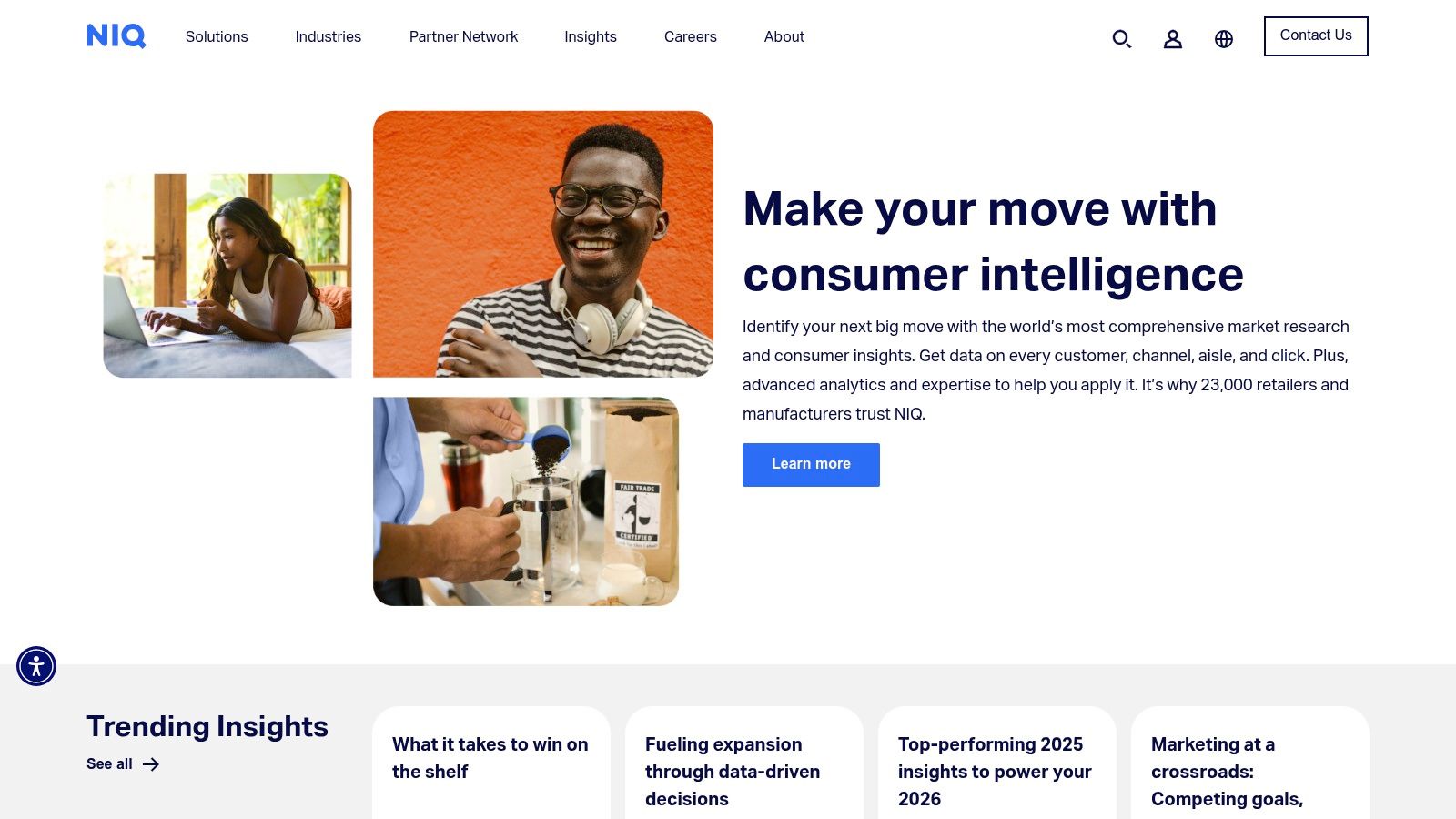
This platform is not for quick, ad-hoc queries but for deep, strategic projects where data integrity and granularity are paramount. The integration of AI into its Discover platform allows junior analysts to more easily navigate massive datasets, identify trends, and formulate hypotheses without needing advanced data science skills, making it one of the best AI tools for market research at the enterprise level.
Core Features & Use Case
- NIQ Discover Platform: An AI-assisted interface that enables rapid exploration of large retail and panel datasets to identify growth opportunities, competitive threats, and consumer behavior shifts.
- Extensive CPG Data: Unmatched coverage of categories, retailers, and geographies, providing a comprehensive view of the market landscape for physical goods.
- AI-Powered Qualitative Research: Integrated capabilities for conducting AI-enhanced interviews, ethnography, and online communities, blending quantitative data with qualitative context.
Practical Tip: Use NIQ Discover's AI features to generate initial hypotheses about a category's performance. For example, ask it to identify "underperforming segments in the salty snacks category for Millennial households" to quickly guide your deeper analysis and save hours of manual data filtering.
| Strengths | Weaknesses |
|---|---|
| Gold-Standard Data Depth: Unrivaled granularity for US CPG analysis. | Enterprise Contracts: Pricing requires significant budget and sales engagement. |
| Strategic & Innovation Focus: Well-suited for market sizing and innovation. | High Barrier to Entry: Not designed for small teams or ad-hoc projects. |
Website: https://nielseniq.com
9. Brandwatch
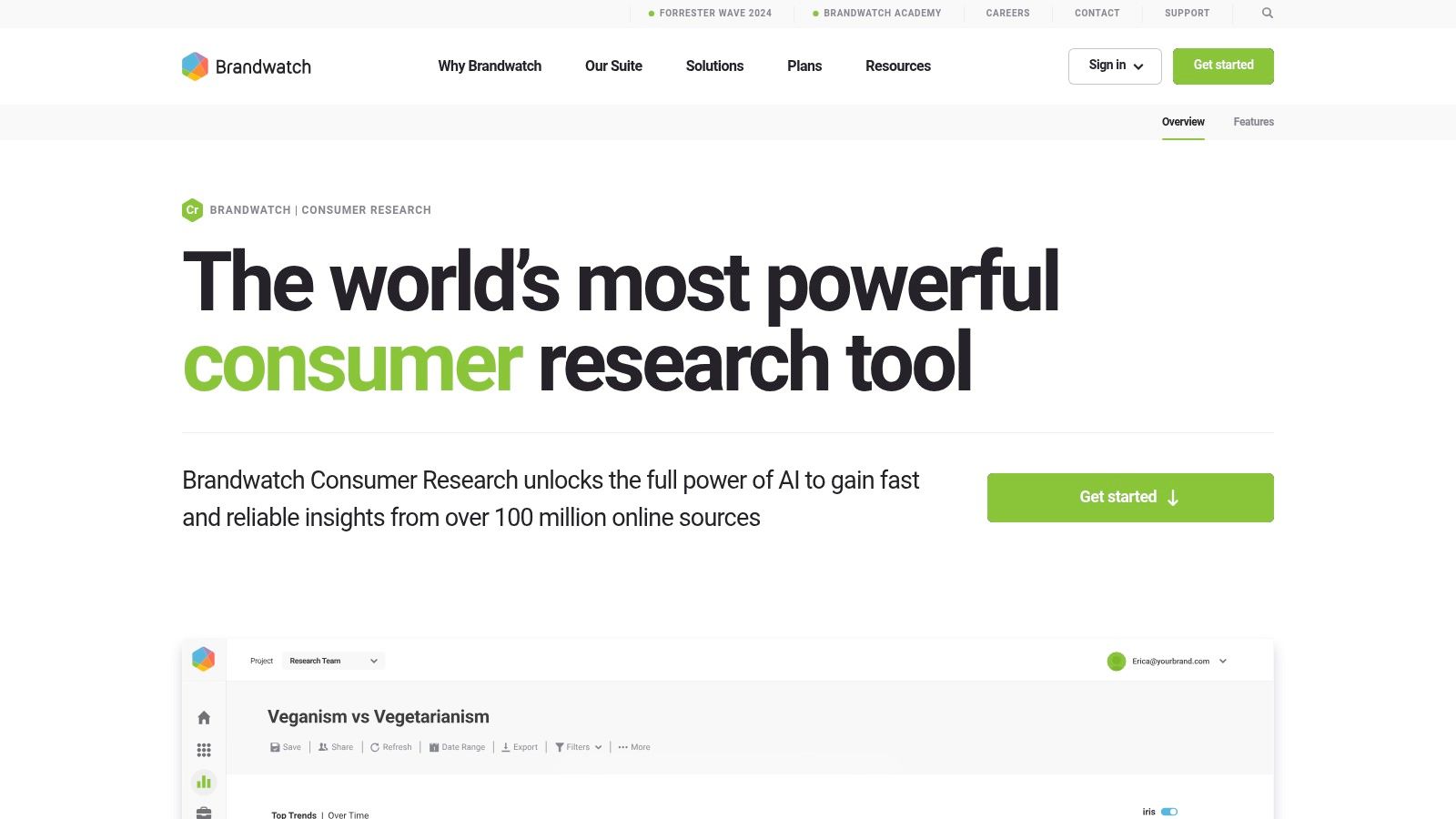
Brandwatch is a premier consumer intelligence platform that has evolved far beyond traditional social listening. For market research teams, it acts as a vast digital focus group, ingesting massive volumes of data from social media, forums, news sites, and product reviews. Its strength lies in using sophisticated AI to analyze these conversations at scale, identifying not just what people are saying, but the underlying sentiment, emotions, and emerging narratives.
This makes it one of the best AI tools for market research when the goal is to understand the "why" behind consumer behavior. Instead of just tracking brand mentions, analysts can map out entire market landscapes, spot unsolicited consumer needs, and monitor the public perception of competitive products in real-time.
Core Features & Use Case
- Large-Scale Data Ingestion: Tracks millions of mentions across a comprehensive range of digital sources, providing a holistic view of the consumer voice.
- AI-Driven Narrative Detection: Its core AI, "Iris," automatically surfaces trends and anomalies in conversation data, saving analysts from manually sifting through noise.
- Customizable Dashboards & Alerts: Build real-time dashboards for specific research projects, brand health monitoring, or competitive intelligence, with alerts for significant changes.
Practical Tip: Use Brandwatch to validate survey findings. If your quantitative data suggests a drop in brand perception, use the platform to dive into the qualitative conversations and identify the specific complaints or competitor actions driving that sentiment shift.
| Strengths | Weaknesses |
|---|---|
| Deep Coverage of Consumer Sources: Excellent for authentic, unfiltered consumer opinions. | Enterprise-Level Pricing: Pricing is not public and requires a sales-led process. |
| Enterprise Services & Support: Strong implementation and ongoing support for large teams. | Annual Commitments: Typically involves annual contracts, making it a significant investment. |
Website: https://www.brandwatch.com/products/consumer-research/
10. Statista
While primarily known as a massive repository of market statistics and reports, Statista has evolved into a powerful component of the best AI tools for market research toolkit. For junior analysts conducting desk research, its value is twofold: providing a foundational layer of quantitative data and now, through its AI features, offering a more intuitive way to access it. The platform is an essential first stop for validating market size, identifying trends, and sourcing chart-ready data points for presentations.
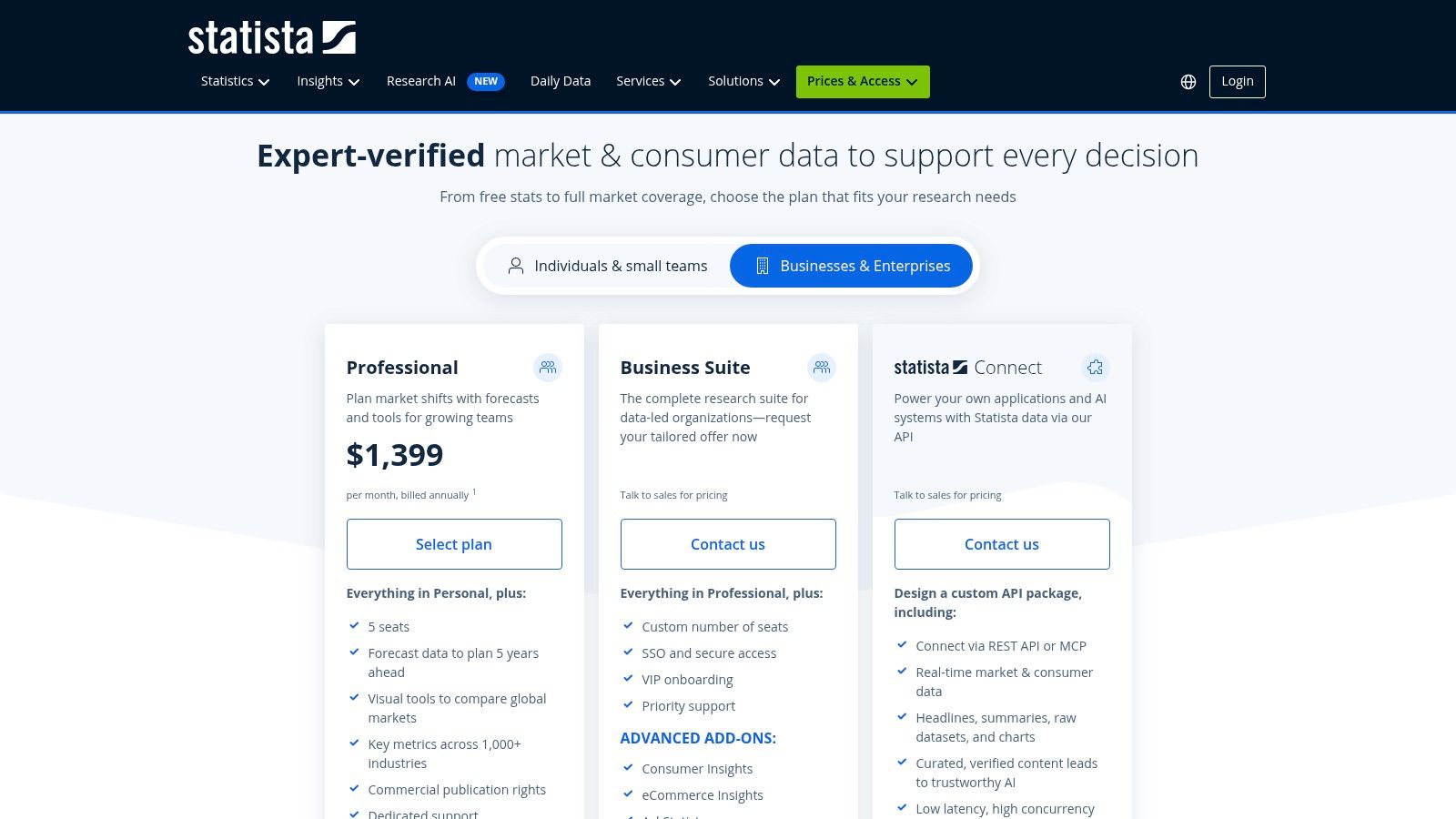
The recent addition of "Research AI" to its business plans allows users to query Statista’s vast database using natural language, significantly speeding up the discovery process. Instead of navigating complex taxonomies, an analyst can simply ask, "What is the projected CAGR for the SaaS market in North America until 2028?" and get immediate, sourced results. This bridges the gap between raw data access and actionable insight.
Core Features & Use Case
- Millions of Statistics: Access a deep well of data points, dossiers, and market outlooks to establish a quantitative baseline for any research project.
- Research AI: Use natural-language queries to find specific data within Statista’s content, reducing manual search time and surfacing relevant information faster.
- API/Connect Access: Programmatically pull statistics into internal dashboards, analysis pipelines, or other applications, a key feature for more technical data teams.
Practical Tip: Use Statista's data to triangulate and validate findings from your primary research. If your survey data points to a new consumer trend, check Statista for supporting industry statistics to strengthen your conclusions.
| Strengths | Weaknesses |
|---|---|
| Excellent for Desk Research: Quickly find market sizing and trends. | Not a Primary Research Tool: Doesn't replace panel or survey data. |
| Slide-Ready Outputs: Data is presented in clean, exportable charts. | Variable Data Freshness: Granularity and recency can vary by topic. |
Website: https://www.statista.com/accounts/businesses
11. SurveyMonkey
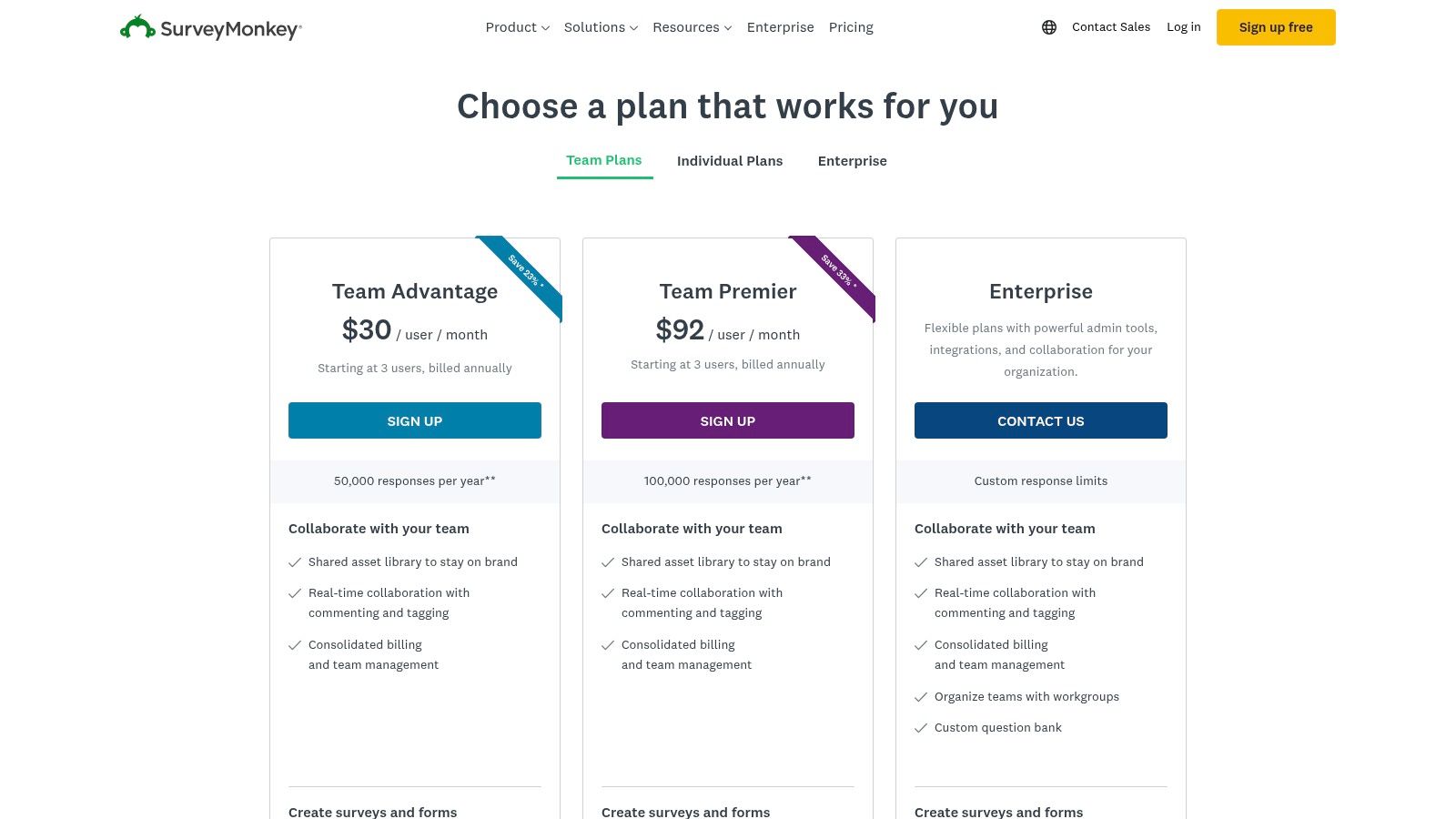
SurveyMonkey is a cornerstone for primary data collection, but its evolution into one of the best AI tools for market research makes it more powerful than ever. The platform now integrates AI-powered features to streamline survey creation and analysis, allowing junior analysts to move faster from question design to actionable insights. It’s an ideal solution for launching primary studies, concept tests, or brand tracking surveys without a steep learning curve.
Its AI capabilities, particularly "Build with AI," help generate relevant questions and structure surveys logically, reducing the risk of bias and improving completion rates. For market researchers, this means less time spent on the mechanics of survey design and more time focusing on the strategic goals of the research. SurveyMonkey remains an accessible yet robust tool for gathering proprietary quantitative and qualitative data directly from a target audience.
Core Features & Use Case
- AI-Assisted Survey Creation: The "Build with AI" feature drafts surveys from a simple prompt, suggesting questions, logic, and structure to get you started quickly.
- Advanced Research Methodologies: Natively supports complex question types like MaxDiff, TURF analysis, and conjoint analysis, which are crucial for product and pricing research.
- AI-Powered Text Analysis: Automatically categorizes and applies sentiment to open-ended text responses, saving hours of manual coding and providing a quick summary of qualitative feedback.
Practical Tip: Use SurveyMonkey's AI text analysis to get a quick read on open-ended feedback. Export the AI-generated tags and sentiment scores alongside the raw responses (CSV/XLS) to enrich your quantitative analysis in tools like Excel or Tableau.
| Strengths | Weaknesses |
|---|---|
| Broad Question Types: Supports everything from basic polls to MaxDiff. | Panel Costs: Accessing SurveyMonkey Audience for respondents is an add-on. |
| Multiple Export Options: Easily export data to CSV, XLS, PPT, and SPSS. | Gated Enterprise Features: SSO and HIPAA compliance require higher-tier plans. |
Website: https://www.surveymonkey.com/pricing/
12. SparkToro
SparkToro is an audience intelligence platform that quickly maps the online behavior of any target audience. Instead of traditional surveys, it crawls trillions of public web pages and social profiles to instantly reveal what a specific group reads, watches, listens to, and follows. This makes it an exceptionally powerful tool for market researchers and demand-gen specialists needing to validate persona assumptions and identify high-leverage marketing channels without launching a full-scale research project.
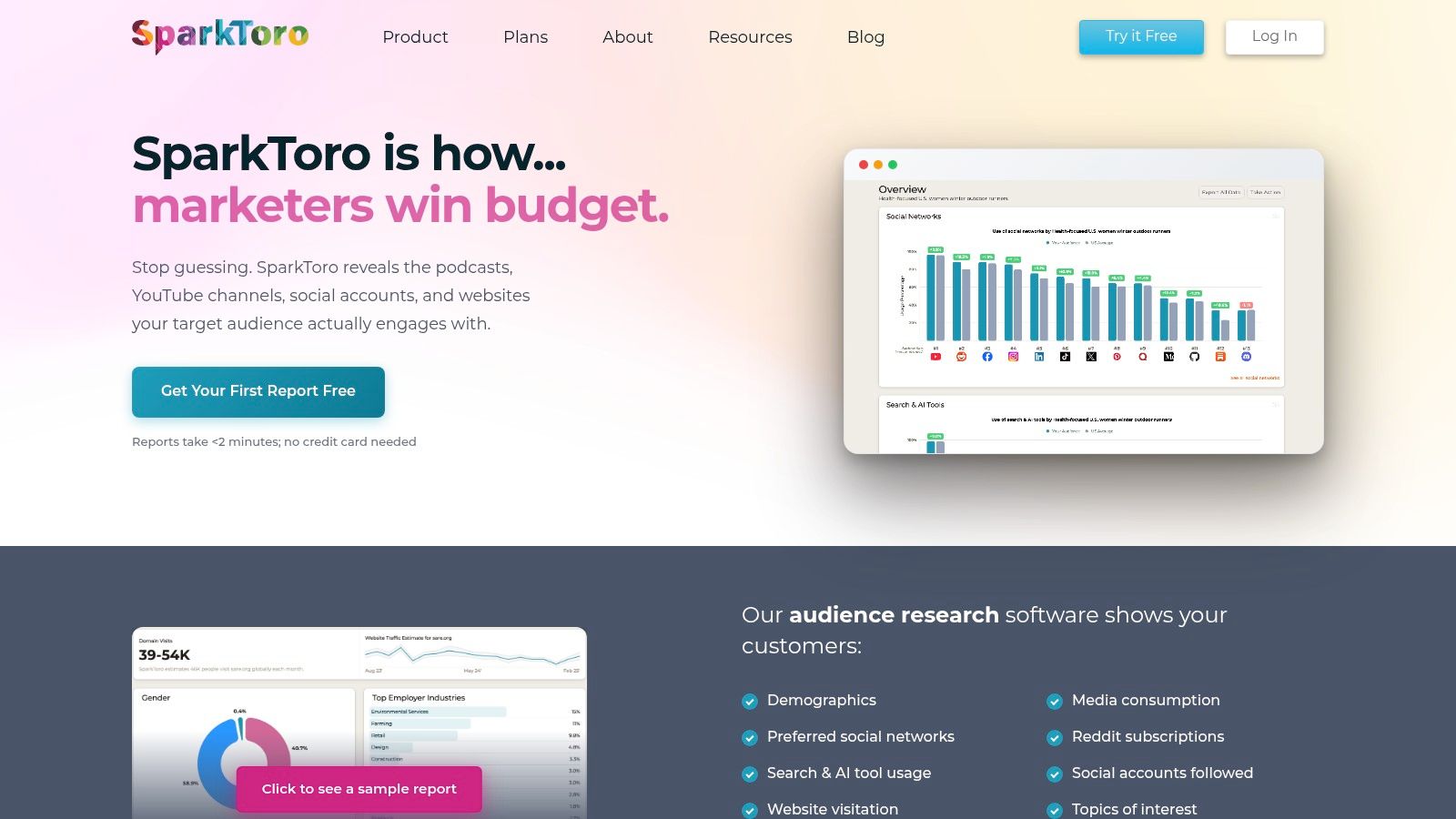
The platform’s core strength is turning a simple, natural-language query like "My audience frequently visits websites about… specialty coffee" into a prioritized list of influential sources. For junior analysts, this provides a rapid, data-backed foundation for content strategy, PR outreach, or partnership targeting, moving beyond guesswork and into strategic action. SparkToro is one of the best AI tools for market research when the goal is qualitative channel discovery and persona enrichment.
Core Features & Use Case
- Natural-Language Audience Queries: Describe your audience based on their interests, job titles, or online behavior to generate a detailed profile of their digital consumption habits.
- Clickstream-Informed Insights: Delivers ranked lists of websites, social accounts, YouTube channels, and podcasts that your target audience engages with most.
- Contact Data & CSV Export: Provides contact information for discovered sources and allows for easy data export, enabling seamless integration into outreach or CRM workflows.
Practical Tip: Use SparkToro to discover "hidden gem" influencers and niche podcasts. A quick search can reveal smaller, highly-engaged communities that larger competitors have overlooked, providing an edge for targeted campaigns.
| Strengths | Weaknesses |
|---|---|
| Very fast for validating personas and identifying channels. | Not a replacement for panel-based quantitative research. |
| Affordable multi-user tiers and a generous free tier for testing. | Relies on public behavior, may miss insights from private groups. |
Website: https://sparktoro.com
Top 12 AI Market Research Tools Comparison
| Tool | Core features | UX / Quality (★) | Value & Price (💰) | Target audience (👥) | Unique features (✨) |
|---|---|---|---|---|---|
| 🏆 Row Sherpa | Batch AI CSV processing; per-row validated JSON/CSV; async jobs; web-search enrichment; public API | ★★★★☆ Predictable, repeatable outputs | 💰 Usage-based tiers (Free → Pro); clear row/token limits | 👥 Junior analysts, sales ops, VC & market researchers | ✨ Per-row prompt enforcement; rerunnable prompts; schema validation |
| G2 | Verified user reviews; Grid/Index reports; vendor links | ★★★☆☆ Real-user signals; depth varies by vendor | 💰 Free to browse; some gated content | 👥 Buyers shortlisting vendors & procurement | ✨ Crowd-validated reviews and comparison grids |
| Capterra | Vendor pages; filters for features/pricing; demo requests | ★★★☆☆ Good for initial shortlists | 💰 Free discovery; sponsored placements possible | 👥 SMB & enterprise buyers starting vendor search | ✨ Feature filters + buyer methodology notes |
| GetApp | SMB-focused leaderboards; scoring; integration filters | ★★★☆☆ Quick SMB-oriented comparisons | 💰 Free; highlights SMB-fit tools | 👥 Small teams and SMB buyers | ✨ Category leaderboards with scoring |
| Product Hunt | Product launches; community feedback; topic feeds | ★★☆☆☆ Early signals; product maturity varies | 💰 Free discovery; requires due diligence | 👥 Early adopters, builders, scouts | ✨ Launch-era community reactions & votes |
| Similarweb | Traffic, audience demographics, channel benchmarking | ★★★★☆ Actionable market & channel insights | 💰 Tiered pricing; some packages public | 👥 Growth, marketing & market analysts | ✨ Channel benchmarking + alerts |
| AlphaSense | Filings, transcripts, premium research; AI summaries | ★★★★☆ Deep qualitative synthesis | 💰 Enterprise, sales-led pricing | 👥 Finance, consulting, corp dev teams | ✨ Premium docs + analyst-style summarization |
| NIQ (NielsenIQ) | CPG scanner & panel data; AI-assisted exploration | ★★★★☆ Gold-standard category depth | 💰 Enterprise contracts; quote-based | 👥 CPG strategy, innovation & insights teams | ✨ Panel/scanner data with AI exploration tools |
| Brandwatch | Social listening; sentiment, emotion & narrative detection | ★★★★☆ Deep social/web coverage | 💰 Sales-led enterprise pricing | 👥 Brand & market research teams | ✨ Narrative & emotion detection at scale |
| Statista | Millions of stats & dossiers; Research AI & API | ★★★★☆ Excellent for desk research | 💰 Clear business plans; API access | 👥 Analysts, researchers, content teams | ✨ Massive stats repo + natural-language querying |
| SurveyMonkey | AI-assisted survey design; advanced MR methods; exports | ★★★★☆ Easy primary research & exports | 💰 Transparent pricing; panel add-ons may cost more | 👥 Researchers, product & marketing teams | ✨ AI survey builder + advanced MR question types |
| SparkToro | Audience queries; clickstream-informed channel lists; contacts | ★★★★☆ Fast persona validation & channel discovery | 💰 Affordable multi-user tiers + free tier | 👥 Demand-gen, marketers, small teams | ✨ Ranked channel lists & CSV contact exports |
Integrating AI into Your Workflow: A Practical Blueprint
Navigating the landscape of AI-powered market research tools can feel like exploring a new frontier. We've journeyed through a comprehensive list, from the web and audience intelligence of Similarweb and SparkToro to the consumer sentiment analysis provided by Brandwatch and the direct feedback mechanisms of SurveyMonkey. The key takeaway is clear: the era of manual data wrangling and surface-level analysis is rapidly being replaced by a more intelligent, automated, and insightful approach.
The tools we've explored, including industry stalwarts like NIQ and specialized platforms like AlphaSense, demonstrate a fundamental shift. Your role as a junior analyst or specialist is evolving. The value you provide is no longer just in the diligent collection of data, but in your ability to synthesize insights, ask strategic questions, and drive decisions based on a richer, more nuanced understanding of the market. AI is not here to replace your critical thinking; it's here to supercharge it.
Your Path from Traditional to AI-Powered Research
Making the leap from traditional methods to an AI-augmented workflow requires a strategic, phased approach. It's not about adopting every shiny new tool at once. It's about identifying the most significant bottlenecks in your current process and finding a targeted solution.
Consider these steps as you build your modern market research stack:
- Identify Your Core Bottleneck: Where do you spend the most time on low-value, repetitive tasks? Is it scraping websites for competitor data? Is it cleaning and enriching lead lists? Is it manually cross-referencing company information from G2 or Capterra? Pinpointing this primary pain point is your first critical step.
- Start with a 'Connector' Tool: Instead of overhauling your entire process, begin with a tool that acts as a central hub or an automation layer. A platform like Row Sherpa is designed for this exact purpose, allowing you to pull data from multiple sources, run AI-driven analyses like sentiment or entity extraction, and push the results directly into your existing spreadsheets. This approach minimizes disruption while maximizing immediate impact.
- Layer in Specialized Platforms: Once you have an automation engine in place, you can strategically integrate more specialized tools. If deep competitive intelligence is your goal, you might add Similarweb to your stack and use your 'connector' tool to automate data pulls. If audience persona development is key, SparkToro becomes the next logical addition.
- Develop Standard Operating Procedures (SOPs): Document your new, AI-powered workflows. Create templates and clear, repeatable processes for tasks like "Quarterly Competitor Feature Analysis" or "Weekly Investment Prospect Enrichment." This ensures consistency, simplifies onboarding for new team members, and makes your contributions scalable across the organization.
Selecting the Right Tool for Your Team
Choosing from the best AI tools for market research depends entirely on your specific context. A VC analyst's needs differ significantly from those of a demand-generation specialist. Before committing to a platform, evaluate it against these crucial factors:
- Integration and Interoperability: Does the tool play well with others? Look for robust API access or, at a minimum, simple CSV import/export functionality. The value of these tools multiplies when they can communicate with your CRM, spreadsheets, and other data sources.
- Scalability and Pricing: A tool that works for a small-scale project might become prohibitively expensive as your needs grow. Scrutinize pricing tiers carefully. Pay attention to usage-based costs, such as API call limits or the number of reports you can generate.
- Learning Curve and Usability: As a busy analyst, you don't have weeks to spend on training. The ideal tool should have an intuitive interface that allows you to get started and see value quickly. A steep learning curve can negate the time-saving benefits the tool promises.
- Data Accuracy and Freshness: For any market research tool, the underlying data is paramount. Investigate the sources of the data. How often is it updated? What is the margin of error? Trustworthy insights can only be built on a foundation of reliable data.
The future of market research is not about replacing human intellect but augmenting it. By embracing these powerful AI tools, you are positioning yourself not just as a data processor, but as a strategic analyst capable of uncovering the signals that drive real business growth.
Ready to eliminate the manual, repetitive tasks from your market research workflow? Row Sherpa is the AI-native automation platform that connects directly to your spreadsheets, allowing you to enrich data, analyze sentiment, and extract insights from all the sources mentioned in this article without writing a single line of code. Start building smarter, faster research processes today by visiting Row Sherpa.