12 Ai tools for market research You Should Know
Discover the top 12 ai tools for market research strategies and tips. Complete guide with actionable insights.
Market research has moved beyond manual data sifting and tedious survey analysis. The new standard involves leveraging specialized platforms that use artificial intelligence to deliver deeper, faster, and more accurate insights. The core challenge is no longer just gathering data, but efficiently processing vast datasets to uncover competitive advantages, understand consumer behavior, and identify emerging trends before they become mainstream. This is where dedicated AI tools for market research become essential, transforming raw information into strategic intelligence.
This guide is designed to help you navigate the complex ecosystem of market research software. We've compiled a great list of the best platforms available, moving beyond generic marketing copy to provide a detailed, actionable analysis of each tool. For every entry, you'll find a clear breakdown of its core function, key features, and ideal use cases. We also offer an honest assessment of potential limitations and practical considerations for implementation.
Whether you're a venture capital analyst tracking industry disruption, a sales ops manager refining your go-to-market strategy, or part of an insights team building a data-driven culture, this resource will help you find the right solution for your specific needs. Each review includes screenshots and direct links to help you evaluate the options quickly. Our goal is to equip you with the information necessary to select and implement tools that will directly impact your team's ability to make smarter, faster decisions. We'll explore everything from competitive intelligence platforms like Similarweb to qualitative analysis tools like Yabble and large-scale data enrichment solutions like Row Sherpa.
1. Row Sherpa
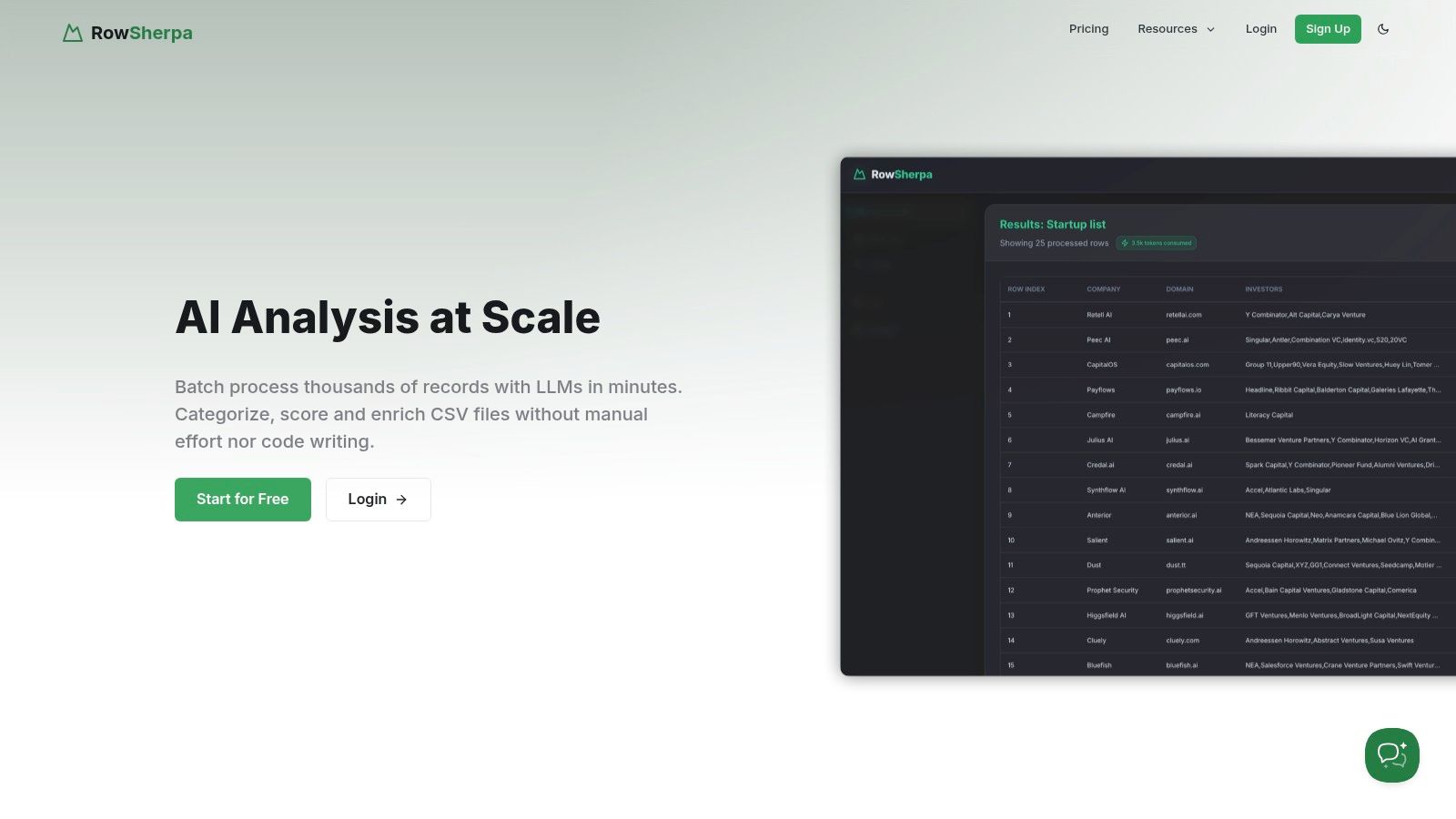
Row Sherpa is designed as a powerful and practical solution for teams needing to perform large-scale, consistent data enrichment and classification. It uniquely addresses a common bottleneck in market research: how to apply the nuanced logic of a Large Language Model (LLM) across thousands of data points without hitting context limits or introducing inconsistencies. By processing data row-by-row with a single, validated prompt, it delivers predictable, structured outputs at scale.
Let's take the example of analyzing feedback questionnaires for instance. An LLM can analyze open text survey responses in no time to extract topics or determine sentiment efficiently. This automation simplifies the process significantly, eliminating the need for manual analysis.
This makes it a great tool for operationalizing complex analysis. Instead of manual processing or intricate scripting, teams can build and save repeatable AI-driven workflows, making it one of the most reliable ai tools for market research for recurring tasks.
Core Capabilities & Strategic Advantages
Row Sherpa excels where consistency and scale are paramount. Its no-code interface democratizes access to sophisticated LLM processing, while its public API ensures it can be integrated directly into automated data pipelines for more technical users.
-
Batch Processing at Scale: The platform’s core strength is its ability to apply one prompt to thousands of individual rows in a CSV file. This asynchronous process avoids the typical limitations and hallucinations of feeding large datasets into a single LLM context window.
-
Structured Output: It forces outputs into a clean JSON or CSV format, ensuring the results are immediately usable for analysis, CRM import, or further processing without manual cleanup.
-
Web-Augmented Context: An optional live web search feature enriches each row with fresh, contextual data before processing. This dramatically improves the quality of analysis for tasks like company classification or lead qualification, as the LLM has more relevant information to work with.
-
Repeatable Workflows: Users can save prompts and job configurations, creating a library of reusable "skills" that can be applied to new datasets. This is ideal for ongoing market tracking, quarterly competitive analysis, or continuous CRM data hygiene.
Pricing Structure
Row Sherpa offers a transparent, usage-based model that scales with team needs. A free tier is available for testing, while paid plans provide higher capacity.
-
Free Tier: For small-scale tests.
-
Starter: $49/month (5,000 rows / 1,000 web-search rows).
-
Premium: $149/month (15,000 rows / 2,500 web-search rows).
-
Pro: $449/month (30,000 rows / 5,000 web-search rows).
Each plan clearly outlines token and output-field limits, helping teams choose a predictable capacity level.
| Feature Analysis | Details & Use Case |
|---|---|
| Ideal For | Sales Ops, VCs, Market Insights Teams, and Data Analysts needing to enrich, classify, or extract structured data from large CSV files (e.g., company lists, survey responses, product descriptions). |
| Primary Workflow | Upload a CSV, craft and validate a single-row prompt, configure output fields, and run the job asynchronously. Download the structured results or retrieve them via the API. |
| Key Differentiator | Predictability at scale. It transforms an LLM's creative capabilities into a reliable, consistent data processing engine for operational workflows. The public API makes it a true infrastructure component. |
| Limitations | The 30-day data retention policy requires users to manage their own long-term storage. It is purpose-built for CSV processing and lacks the broad, native integrations of some all-in-one platforms. |
| Website | https://rowsherpa.com |
2. G2
G2 is less a direct AI tool and more an indispensable meta-resource for discovering and vetting them. It serves as the largest B2B software marketplace, providing a structured environment to explore the landscape of AI tools for market research. Its real power lies in the depth of its user-generated reviews and proprietary comparison reports, which cut through marketing noise to provide a clearer picture of a tool's real-world performance.
For market researchers, G2 is the first stop for competitive intelligence and vendor discovery. Instead of relying on vendor-supplied information, you can analyze its "Grid" reports, which plot tools based on user satisfaction and market presence. This provides an immediate visual shortlist of category leaders, challengers, and niche innovators.
Key Features & Use Cases
-
Grid® and Index Reports: Use these reports to quickly compare the top players in categories like "Market Intelligence" or "Consumer Insights" and identify emerging AI-powered solutions.
-
Verified User Reviews: Filter reviews by company size or role to see how peers are using a specific AI tool and what limitations they've encountered. This is invaluable for due diligence.
-
Category Filtering: Drill down within broad categories using specific filters like "Generative AI" to pinpoint tools with the exact capabilities you need for tasks like automated summary generation or sentiment analysis.
Pro-Tip: Create a free account to follow specific software categories. G2 will send you alerts when new tools enter the space or when existing ones release significant updates, keeping your competitive landscape analysis continuously up-to-date.
| Pros | Cons |
|---|---|
| Extensive vendor and category coverage | Sponsored placements can artificially boost visibility |
| Verified, in-depth user reviews provide authenticity | Broad categories sometimes group dissimilar tools together |
| Structured comparison reports simplify evaluation |
Website: https://www.g2.com
3. Capterra – Market Research Software
Similar to G2, Capterra operates as a comprehensive software discovery platform rather than a direct AI tool. Its value for market researchers is in its extensive, filterable directory, which allows for rapid identification and comparison of software solutions, including a growing number of AI tools for market research. It is particularly useful for building an initial longlist of potential vendors before diving into deeper evaluation.
Capterra's strength lies in its user-friendly interface and practical filters. You can quickly narrow down over 200 market research tools by specifying features like "Generative AI" or "AI Copilot," along with practical considerations such as deployment type (Cloud, SaaS, Web-Based) and pricing options (e.g., free trial availability). This makes it an efficient starting point for teams needing a quick overview of the available technology landscape.
Key Features & Use Cases
-
Advanced Filtering: Use the robust filter options to create a specific shortlist of tools. For example, you can find all cloud-based market research tools with a free trial and generative AI capabilities.
-
Side-by-Side Comparisons: Select up to four tools from the directory to compare them directly on features, pricing models, and user ratings, streamlining the initial vetting process.
-
User Reviews and Guides: Access user-generated reviews and detailed buyer's guides to understand the common applications and potential drawbacks of different software categories before committing to demos.
Pro-Tip: Pay attention to the "Sponsored" tags. While useful for discovery, these listings are paid placements. Always sort by "Highest Rated" or "Most Reviews" to get a more objective view of the market leaders based on user feedback.
| Pros | Cons |
|---|---|
| Free to use with comprehensive filters | Sponsored listings appear first and can affect rankings |
| Makes it easy to compare tools and access vendors | Depth of technical detail varies by vendor listing |
| Includes practical details like pricing models |
Website: https://www.capterra.com/market-research-software/
4. Product Hunt
Product Hunt is a dynamic discovery hub for new technology, making it a goldmine for identifying the very latest AI tools for market research before they hit the mainstream. It functions as a daily leaderboard for new tech products, where the community's upvotes and comments serve as an early signal for a tool's potential utility and market traction. Unlike established review sites, its value lies in its real-time, ground-floor perspective on innovation.
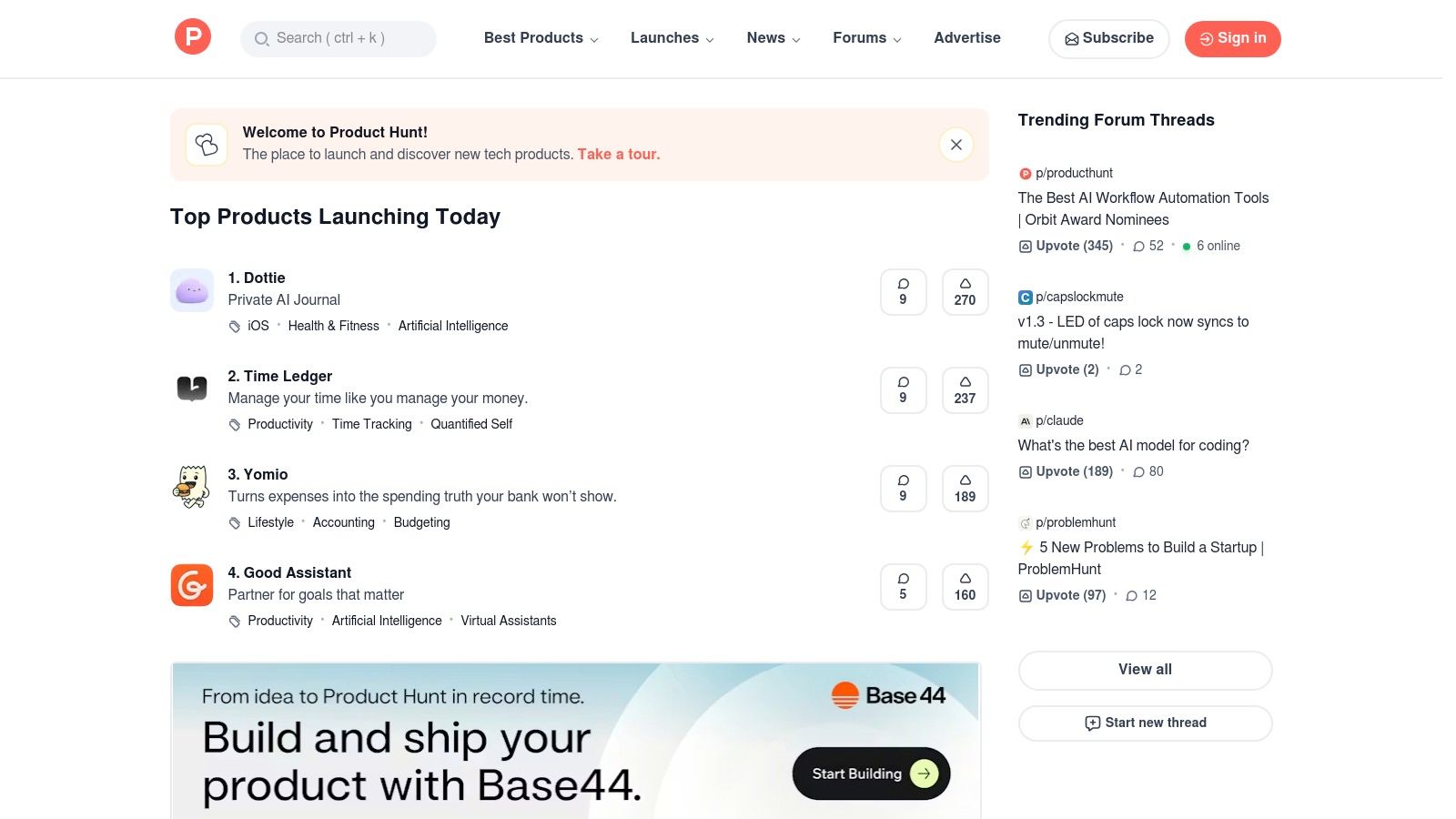
For market researchers, VCs, and competitive analysts, Product Hunt is an essential resource for horizon scanning. You can monitor launches of novel AI-powered analytics scrapers, automated research assistants, or niche data enrichment services. The platform allows direct engagement with the founders in the comments, offering a unique opportunity to ask specific questions about a tool's capabilities or roadmap.
Key Features & Use Cases
-
Daily Product Launches: Check the daily leaderboards to spot emerging AI tools as they launch and gauge initial community reception through upvotes and discussions.
-
Topic Monitoring: Follow specific topics like "Marketing," "Analytics," or "Artificial Intelligence" to get a curated feed of relevant new tools directly in your dashboard.
-
Founder Engagement: Use the comment sections on product pages to ask founders direct questions about use cases, integrations, or limitations, gathering firsthand competitive intelligence.
Pro-Tip: Create collections to privately save and categorize promising tools you discover. A collection titled "AI Market Research Tools" or "Competitor Watchlist" helps you build a custom repository for future evaluation without losing track of early-stage finds.
| Pros | Cons |
|---|---|
| Excellent for early discovery of emerging tools | Community voting can be influenced by hype over utility |
| Direct access to founders and community feedback | Many products are very early-stage and may be immature |
| Curated collections help organize discoveries | Signal-to-noise ratio can be high at times |
Website: https://www.producthunt.com
5. Semrush (Traffic & Market Toolkit)
Semrush is a powerhouse for digital competitive intelligence, and its Market Explorer and Traffic Analytics toolkits leverage AI to provide a deep, data-driven view of any digital market. While known for SEO, its market research capabilities allow teams to analyze competitor web traffic, audience demographics, and marketing strategies at scale, making it one of the most effective AI tools for market research focused on digital ecosystems.
For market researchers, Semrush translates raw web data into strategic insights. You can instantly estimate a market's size (TAM), identify key players, and see their market share based on traffic. Its AI-powered features help synthesize this complex data into clear summaries and growth quadrants, revealing which competitors are gaining traction and which channels are driving their success. This is crucial for benchmarking, opportunity analysis, and understanding audience overlap between different brands.
Key Features & Use Cases
-
Market Explorer: Get a high-level overview of any industry. Use it to identify top players, market trends, and audience demographics to quickly validate a market or analyze a new vertical.
-
Traffic Analytics: Dive deep into any website's traffic sources, audience geography, and engagement metrics. Compare multiple competitors head-to-head to benchmark performance and uncover their digital marketing mix.
-
AI-Generated Summaries: Semrush uses AI to create actionable summaries and insights within its reports, helping you quickly grasp key market dynamics without sifting through all the raw data yourself.
Pro-Tip: Use the "Bulk Traffic Analysis" feature to upload a list of up to 100 competitor domains. Semrush will generate a comprehensive comparison report, giving you an immediate, wide-angle view of the competitive landscape and audience overlap.
| Pros | Cons |
|---|---|
| Strong competitive web traffic and digital market data | Full market/traffic access requires a separate toolkit |
| Actionable dashboards for market sizing and trends | Costs can add up per user and per toolkit add-on |
| Trials available to evaluate specific features | Focus is entirely on digital data, not offline markets |
Website: https://www.semrush.com
6. Similarweb
Similarweb is a cornerstone digital intelligence platform that provides a macroscopic view of the entire digital landscape. While known for its robust web traffic analytics, its integration of AI-powered insights makes it a formidable tool for competitive benchmarking and channel analysis. It excels at translating raw digital signals-like site visits, engagement rates, and traffic sources-into strategic market intelligence.
For market researchers, Similarweb answers critical questions about competitor performance and audience behavior. You can instantly benchmark your digital footprint against key rivals, identify which marketing channels are driving their growth, and understand the demographic and geographic makeup of their audience. Its AI features, available in team packages, help distill these vast datasets into actionable summaries and trend alerts.
Key Features & Use Cases
-
Traffic & Engagement Metrics: Analyze a competitor's website visits, bounce rate, and session duration to gauge their digital health and audience engagement.
-
Channel Mix Analysis: Deconstruct how competitors acquire traffic, whether through organic search, paid ads, social media, or referrals, to identify opportunities for your own strategy.
-
Audience Demographics: Gain insights into the age, gender, and location of any website's audience to validate your target personas and inform market segmentation.
Pro-Tip: Use the "Alerts" feature to monitor shifts in a competitor's traffic or when they are mentioned in the news. This creates an automated competitive intelligence feed, allowing you to react quickly to market changes.
| Pros | Cons |
|---|---|
| Strong site/app intelligence for benchmarking and channel analysis | Deeper data history and features require higher-tier plans |
| Clear pricing tiers for individuals and teams | Country filtering and some capabilities are limited on entry plans |
Website: https://www.similarweb.com
7. AlphaSense
AlphaSense is an enterprise-grade AI search and market intelligence platform designed for deep corporate and financial analysis. It stands apart from more generalized AI tools for market research by providing access to a vast and exclusive library of premium business content, including broker research, expert call transcripts, and SEC filings. The platform's powerful generative AI capabilities are trained specifically on this high-quality data set.
For competitive intelligence, corporate strategy, and investment teams, AlphaSense is a formidable tool. It replaces the manual process of sifting through thousands of documents with an intelligent search that understands complex financial and strategic queries. Its AI can generate instant summaries of earnings calls or distill key themes from thousands of sources, complete with citations that link directly back to the original documents for verification.
Key Features & Use Cases
-
Generative Search & Smart Summaries: Ask complex questions about a company, market, or trend and receive a synthesized answer with citations. Instantly summarize long documents like earnings reports or expert interviews to grasp key insights quickly.
-
Premium Content Universe: Leverage an extensive collection of proprietary content including Wall Street equity research, expert call transcripts, and global financial filings for unparalleled depth in your research.
-
Company and Industry Analysis: Use the platform to monitor competitors, track industry-specific KPIs, and understand market sentiment with integrated qualitative and quantitative data views.
Pro-Tip: Utilize the "Smart Synonyms" feature to ensure your searches capture all relevant terminology. For instance, a search for "customer churn" will automatically include related terms like "attrition" and "retention," broadening your results without extra effort.
| Pros | Cons |
|---|---|
| High depth and quality of proprietary sources | Enterprise-oriented pricing requires requesting a quote |
| Cited AI answers enhance trust and verifiability | Learning curve to master advanced search features |
| Integrates qualitative and quantitative data well |
Website: https://www.alpha-sense.com
8. CB Insights
CB Insights is a premier market intelligence platform that leverages AI to provide deep insights into private companies, emerging industries, and technology trends. While its foundation is built on a massive proprietary dataset, its AI-powered features transform raw data into predictive signals, making it an essential tool for AI-powered market research, especially for venture capital, M&A, and corporate strategy teams.
The platform excels at identifying nascent trends and scouting promising startups before they hit the mainstream. Its core value lies in its proprietary algorithms like the "Mosaic Score," which predicts a private company's health and potential for success. This predictive layer, combined with natural language search capabilities, allows researchers to move beyond simple data retrieval and into strategic foresight.
Key Features & Use Cases
-
ChatCBI: An AI-powered search and Q&A engine that allows users to ask complex questions across the platform’s entire database of reports, transcripts, and company profiles, generating instant, synthesized answers.
-
Predictive Scoring (Mosaic Score): Use this algorithm to screen and rank private companies based on their health, momentum, and market position, identifying high-potential investment or partnership targets.
-
Browser Analyst Extension: Instantly pull up CB Insights data, competitive landscapes, and AI-generated summaries for any company website you visit, streamlining initial due diligence without leaving the page.
Pro-Tip: Leverage the "Look-alike" company feature to expand your competitive set. After identifying a key player, CB Insights can generate a list of similar companies based on its machine learning model, uncovering under-the-radar competitors or partners.
| Pros | Cons |
|---|---|
| Deep private-company coverage and curated analyst research | Pricing is not public and requires contacting sales |
| Predictive signals are useful for scouting and market sizing | Onboarding is required to get the best results from the platform |
| Powerful AI-driven search saves significant research time |
Website: https://www.cbinsights.com
9. Crunchbase
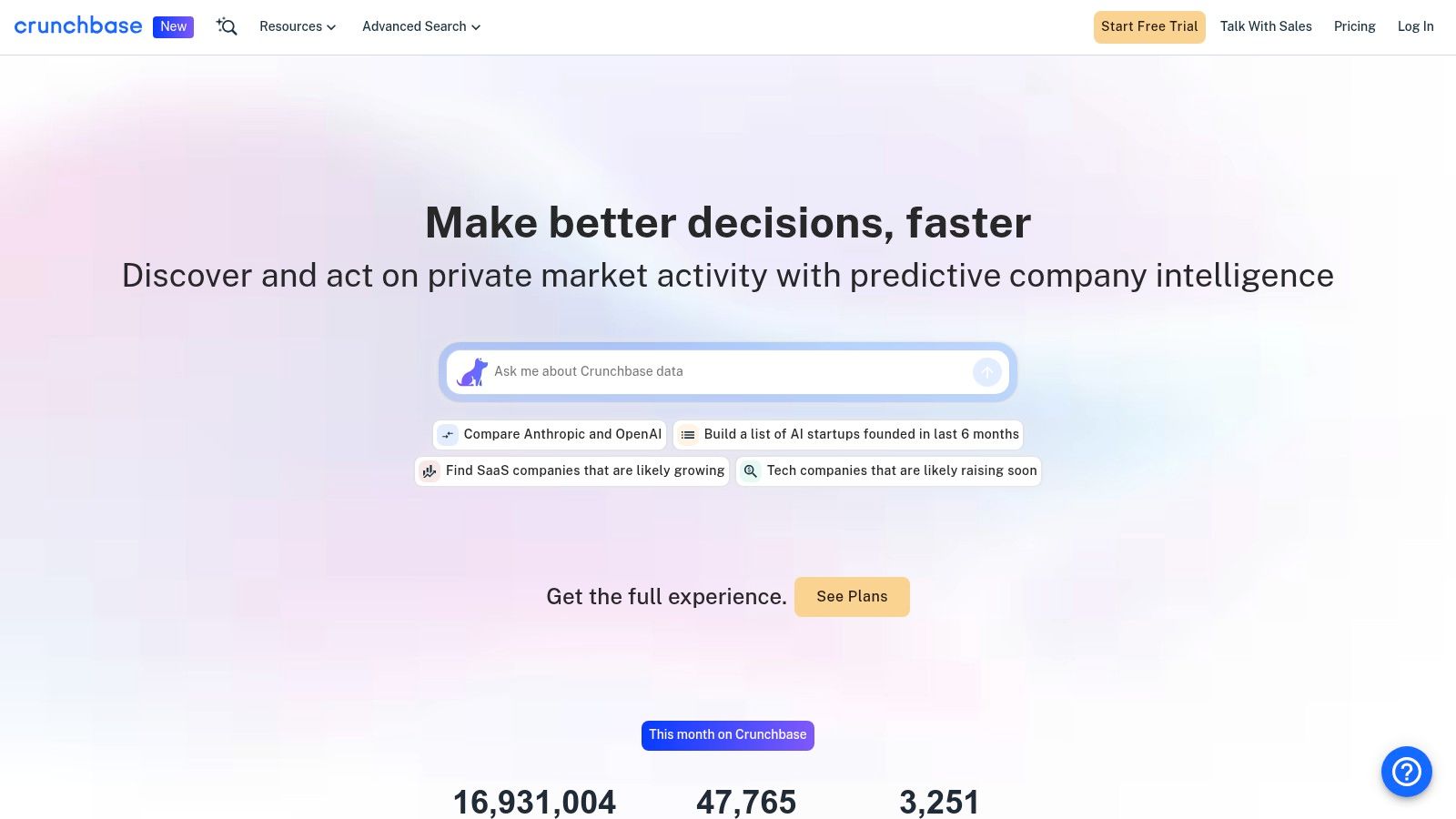
Crunchbase is a foundational database for company and investor information, but its recent AI enhancements transform it into a powerful tool for market landscaping and competitive intelligence. While not a consumer insights platform, it excels at providing the firmographic and funding data essential for B2B ai tools for market research. Its AI-powered search and "AI Scout" features allow researchers to move beyond simple keyword filters and ask complex, natural-language questions about the market.
For market researchers, particularly in venture capital, sales operations, or corporate strategy, Crunchbase is the go-to for mapping ecosystems. You can quickly identify all companies in a specific niche, track their funding rounds, monitor key personnel changes, and understand their growth trajectory. The platform's strength is in structuring this complex data so it can be easily exported and operationalized.
Key Features & Use Cases
-
AI-Powered Search & Scout: Use natural language queries like "show me seed-stage fintech startups in Europe that raised money last quarter" to get instant, summarized results and company lists.
-
Saved Lists and Alerts: Build dynamic lists of competitors or potential investments and receive automated alerts on new funding, acquisitions, or leadership changes to keep your research current.
-
CSV Exports & Salesforce Integration: Easily pull targeted company data for further analysis in other tools or sync it directly with your CRM to enrich prospecting and account intelligence workflows.
Pro-Tip: Combine Crunchbase's AI search with its robust filtering options. Start with a broad natural language query, then use the advanced filters (location, funding stage, employee count) to systematically narrow down the list to a highly qualified set of target companies for deeper analysis.
| Pros | Cons |
|---|---|
| Affordable options for individuals and small teams | Not designed for survey or consumer insights work |
| Easy to operationalize data via exports and CRM sync | Some data and features require add-ons |
| AI search simplifies complex market queries |
Website: https://www.crunchbase.com
10. Yabble
Yabble is an AI-native consumer insights platform designed to rapidly transform vast amounts of unstructured feedback into clear, actionable intelligence. It directly addresses the time-consuming process of coding open-ended survey responses or interview transcripts, using generative AI to automatically synthesize data, identify key themes, and even generate audience simulations. This makes it one of the most powerful ai tools for market research for teams drowning in qualitative data.
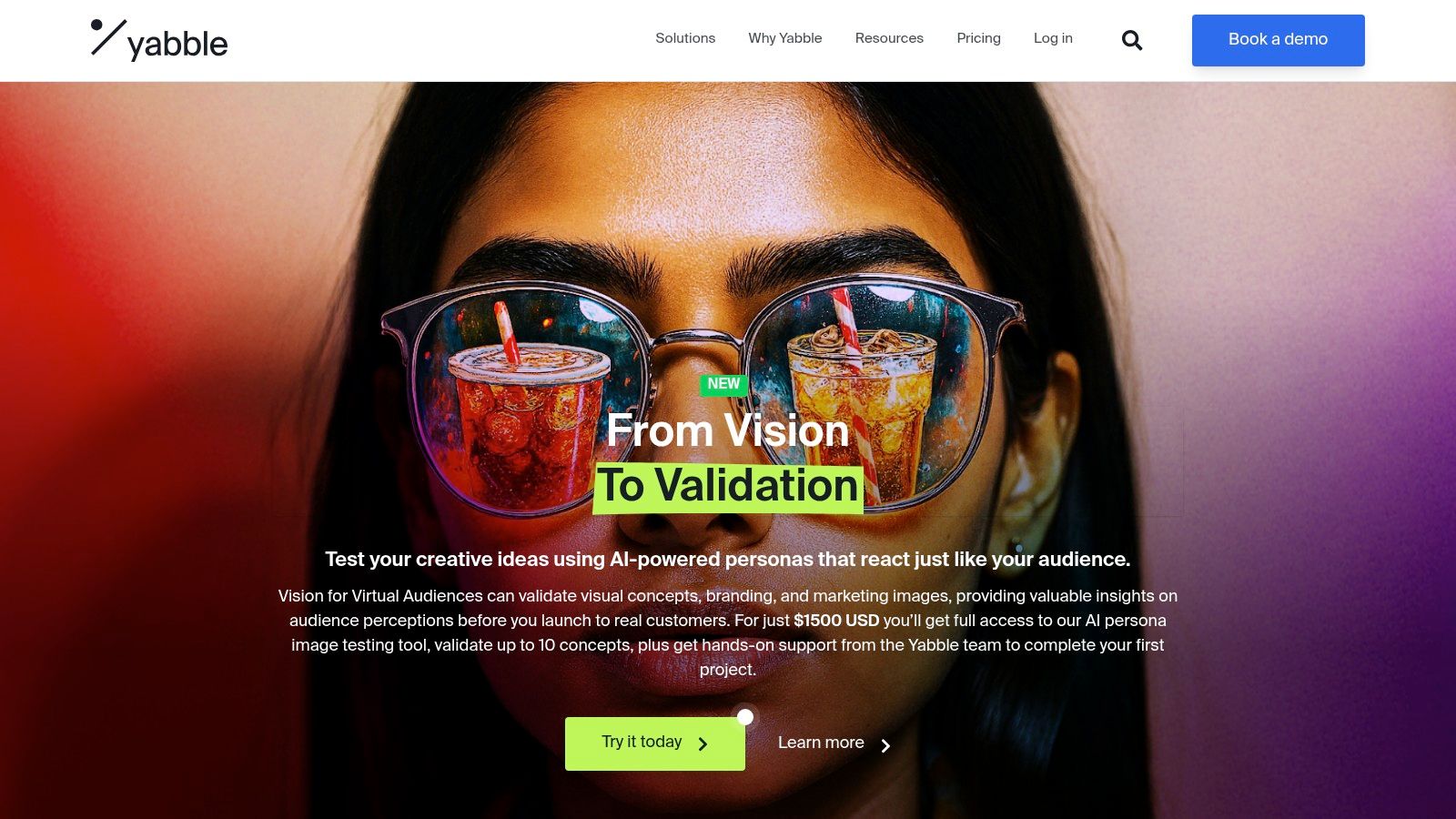
What sets Yabble apart is its purpose-built suite for insights professionals. Instead of a general-purpose AI, its tools like Count (AI coding), Summarize, and Gen (AI chat for data) are tuned for research workflows. Its "Virtual Audiences" feature allows you to simulate survey responses from specific demographic segments, providing a quick way to test hypotheses before launching a full-scale study.
Key Features & Use Cases
-
AI-Powered Thematic Analysis: Upload CSVs of open-ended survey responses or interview transcripts to have Yabble automatically code and group the data into coherent themes, saving hundreds of manual hours.
-
Virtual Audiences: Simulate audience segments to quickly validate new product concepts, messaging, or survey questions without the cost and time of recruiting live panels.
-
Data Summarization & Chat: Use its AI to generate executive summaries from complex datasets or "chat" with your data to ask specific follow-up questions and uncover deeper insights instantly.
Pro-Tip: Use the CSV upload feature to re-analyze historical survey data. You can uncover new themes and insights from past studies that were too time-consuming to manually code at the time.
| Pros | Cons |
|---|---|
| Designed specifically for insights workflows with strong automation | Pricing targets professional teams and starts higher than DIY survey tools |
| Team-friendly licensing model (unlimited users on subscriptions) | Enterprise focus may be more than some small teams need |
| Powerful for synthesizing large-scale qualitative data quickly |
Website: https://www.yabble.com
11. quantilope
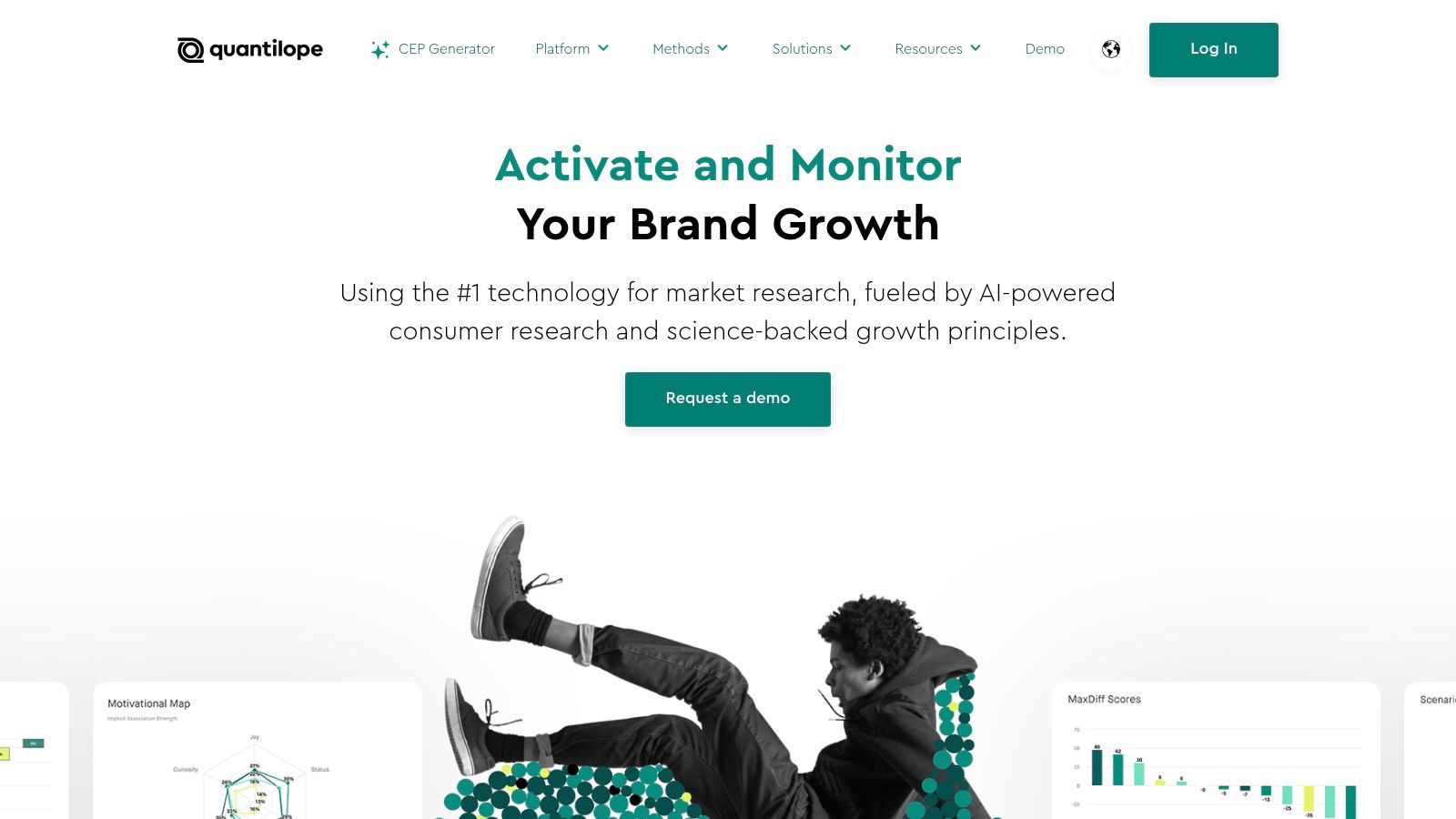
quantilope is an end-to-end consumer research platform that infuses AI into rigorous quantitative and qualitative methodologies. It’s designed for teams that need agency-grade insights without the agency timelines, making it one of the more advanced ai tools for market research. The platform's AI copilot, 'quinn,' assists across the entire research lifecycle, from designing sophisticated surveys with methods like MaxDiff and Conjoint to automatically generating chart headlines and executive summaries from the results.
This approach automates the heavy lifting of advanced research, allowing insights teams to focus on strategy rather than process. For market researchers, quantilope closes the gap between speed and methodological rigor, enabling rapid, iterative concept testing, brand tracking, and UX studies that are both fast and statistically sound.
Key Features & Use Cases
-
AI Copilot 'quinn': Use the AI assistant to draft questionnaires, suggest question types, generate chart headlines, and create narrative summaries of your key findings, significantly speeding up the reporting process.
-
Automated Advanced Methods: Implement complex research techniques like Conjoint Analysis for product optimization or MaxDiff for feature prioritization with automated setup and analysis.
-
End-to-End Insights Automation: Manage the entire research project within one platform, from survey design and fielding to data analysis, visualization, and reporting, all with AI-powered assistance.
Pro-Tip: Leverage quantilope's automated tracking studies for continuous brand health monitoring. The platform's AI can highlight significant shifts in brand perception or competitive positioning over time, turning a complex longitudinal study into a manageable, automated workflow.
| Pros | Cons |
|---|---|
| Agency-grade methods with end-to-end automation | Pricing is oriented to teams and enterprise; not entry-level |
| Multi-language support and strong methodological capabilities | Trial access is limited and available only by request |
| AI assistance speeds up entire research lifecycle |
Website: https://www.quantilope.com
12. Suzy
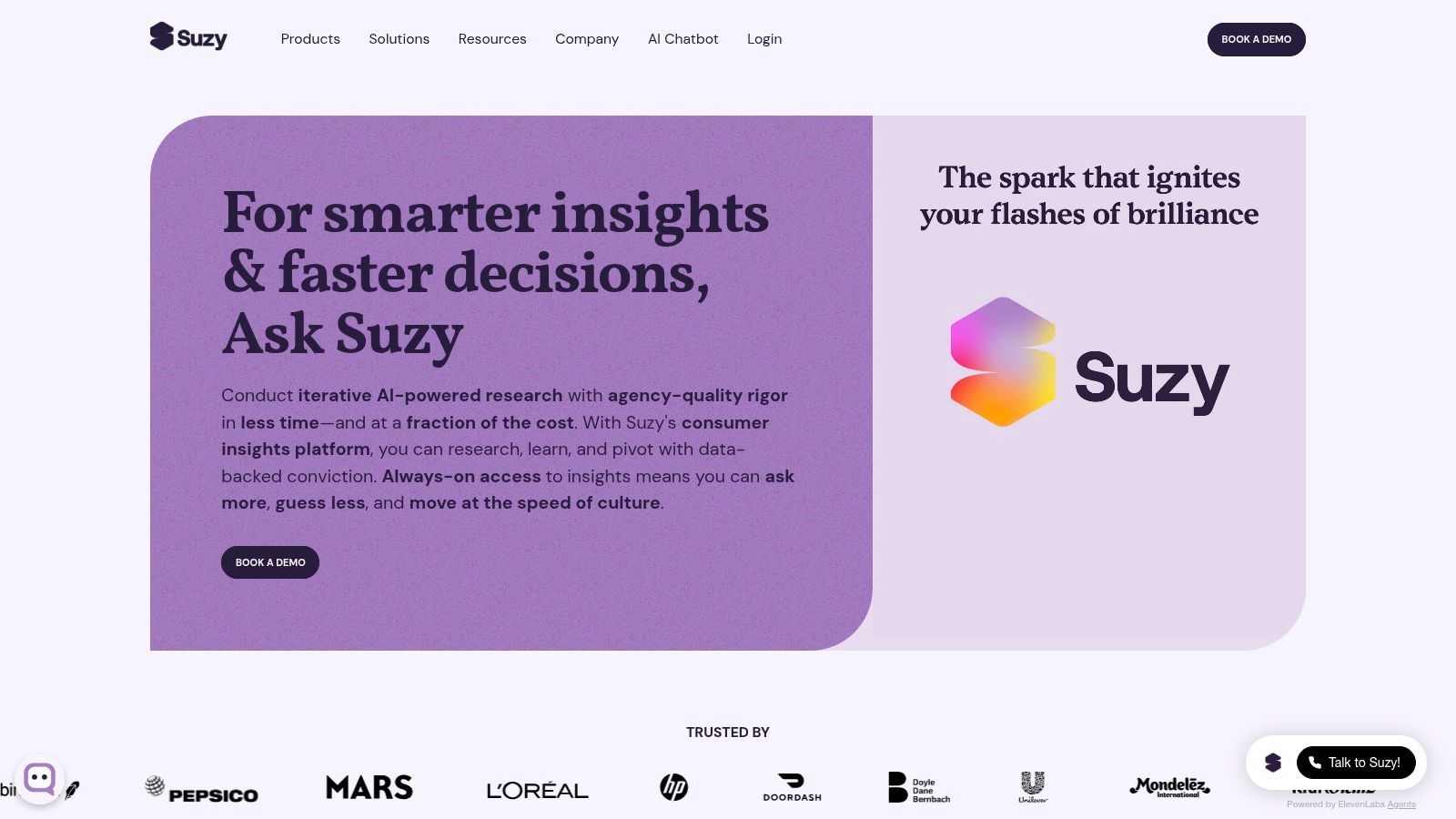
Suzy is an agile consumer insights platform that combines a proprietary audience network with AI-driven research tools. It’s designed for rapid, iterative learning, allowing teams to go from a hypothesis to a data-backed answer in hours, not weeks. The platform's standout feature, 'Ask Suzy', is an AI-powered qualitative assistant that helps you explore consumer sentiment, refine research questions, and generate summaries, making it one of the more accessible AI tools for market research.
This approach is ideal for product managers, marketers, and insights teams who need quick pulse checks on creative concepts, feature ideas, or shifting consumer behaviors. Instead of commissioning a lengthy study, you can launch a quick survey to Suzy's panel and get presentation-ready insights almost immediately.
Key Features & Use Cases
-
Ask Suzy AI Chat: Use the AI assistant to explore initial hypotheses, brainstorm survey questions, or get instant summaries of open-ended feedback without manually sifting through responses.
-
Credit-Based Audience Sampling: Quickly target broad or niche consumer segments for quantitative surveys or qualitative interviews. This is perfect for concept testing, ad creative evaluation, or brand tracking.
-
Presentation-Ready 'Stories': The platform automatically visualizes data and compiles key findings into a shareable 'Story' format, significantly reducing the time spent on reporting and analysis.
Pro-Tip: Use Suzy for iterative research. Launch a small, exploratory survey, analyze the results with Ask Suzy to identify interesting trends, and then launch a follow-up survey to a more targeted audience to dig deeper, all within the same day.
| Pros | Cons |
|---|---|
| Extremely fast turnaround for consumer feedback | Credit model requires careful budget planning |
| Friendly UX makes it accessible for non-researchers | Targeting niche audiences can become expensive quickly |
| Scalable from solo users up to enterprise teams |
Website: https://www.suzy.com
Top 12 AI Market Research Tools Comparison
| Product | Core features | UX / Quality (★) | Price & Value (💰) | Target audience (👥) | Unique selling points (✨) |
|---|---|---|---|---|---|
| Row Sherpa 🏆 | No-code batch CSV LLM enrichment; validated JSON/CSV outputs; async jobs; optional web-search; public API | ★★★★☆ — predictable, repeatable | 💰 Free → Starter $49 / Premium $149 / Pro $449; clear row/token limits | 👥 Sales ops, VC scouts, market researchers, data teams | ✨ Single-prompt per-row consistency; validated outputs; async scale; API |
| G2 | B2B marketplace with verified reviews; Grid/Index/Momentum reports; filters | ★★★★☆ — rich social proof | 💰 Free for buyers; vendor sponsorships affect visibility | 👥 Buyers, procurement, shortlist builders | ✨ Verified reviews + comparative reports |
| Capterra – Market Research Software | Filterable directory; side-by-side comparisons; buyer guides | ★★★★☆ — easy shortlist building | 💰 Free to use; sponsored listings priority | 👥 Buyers creating quick shortlists | ✨ Comprehensive filters for trials, deployment, AI |
| Product Hunt | Daily launches; community feedback; topic collections | ★★★☆☆ — early-signal, variable quality | 💰 Free discovery platform | 👥 Makers, early adopters, product scouts | ✨ Early discovery + community discussion |
| Semrush (Traffic & Market Toolkit) | Market Explorer, Traffic Analytics, AI summaries, dashboards | ★★★★☆ — strong web metrics & dashboards | 💰 Tiered toolkits; can be costly per toolkit/user | 👥 Marketing teams, competitive analysts | ✨ Rich web-traffic intelligence + market sizing |
| Similarweb | Traffic & engagement metrics, geo & channel breakdowns, alerts | ★★★★☆ — reliable benchmarking | 💰 Clear tiers; higher tiers for deeper history | 👥 Competitive analysts, channel managers | ✨ Site/app benchmarking & channel mix |
| AlphaSense | Generative Search with citations; premium filings & research; agents | ★★★★☆ — enterprise-grade depth | 💰 Enterprise pricing (quote) | 👥 Finance, strategy, corp dev teams | ✨ Cited AI answers; deep premium sources |
| CB Insights | Proprietary datasets (Mosaic), AI Q&A (ChatCBI), analyst research | ★★★★☆ — predictive signals | 💰 Enterprise pricing (quote) | 👥 VCs, corporate strategy, scouting teams | ✨ Predictive scoring & curated private-company data |
| Crunchbase | Company database; AI search & Scout; lists, alerts, CSV exports | ★★★☆☆ — pragmatic, export-friendly | 💰 Affordable tiers; add‑ons for contacts | 👥 SMBs, sales, recruiters, scouts | ✨ Easy exports & CRM sync; accessible pricing |
| Yabble | AI-native consumer insights; synthesis, Virtual Audiences; CSV/API | ★★★★☆ — insights-focused UX | 💰 Team pricing (higher than DIY) | 👥 Insights teams, qual/quant researchers | ✨ Virtual Audiences; unlimited user licenses on subs |
| quantilope | Automated advanced methods (Conjoint, MaxDiff); AI copilot 'quinn' | ★★★★☆ — methodologically strong | 💰 Enterprise-oriented pricing | 👥 Brand, UX researchers, agencies | ✨ Rigorous statistical methods + AI copilot |
| Suzy | Always-on Signals; AI chat; credit-based sampling; Stories summaries | ★★★★☆ — fast, presentation-ready | 💰 Credit model — plan-dependent costs | 👥 Marketers, product teams, quick-pulse researchers | ✨ Fast conversational research + credit sampling |
Final Thoughts
The landscape of market research is undergoing a seismic shift, driven by the rapid evolution and adoption of artificial intelligence. As we've explored, the days of relying solely on time-consuming manual analysis, expensive focus groups, and limited survey data are numbered. The modern market researcher, sales operator, or investment analyst has an arsenal of sophisticated AI tools for market research at their disposal, each designed to unlock deeper, faster, and more actionable insights from an ocean of data.
This guide has walked through a curated selection of platforms, from competitive intelligence giants like Semrush and Similarweb to specialized qualitative analysis tools like Yabble and enterprise-grade market intelligence systems like AlphaSense. Each tool offers a unique lens through which to view your market, competitors, and customers. The core takeaway is this: AI is not a replacement for human intellect but a powerful amplifier, automating the tedious and illuminating the hidden patterns that drive strategic decisions.
Your Roadmap to AI-Powered Market Research
Choosing the right tool can feel overwhelming, but the decision becomes clearer when you ground it in your specific operational needs and strategic goals. Before committing to a platform, it's crucial to map out your existing workflows and identify the most significant bottlenecks.
-
For Venture Capital and Investment Analysts: Your focus is on market sizing, competitive landscaping, and identifying emerging trends. Tools like CB Insights, Crunchbase, and AlphaSense provide the macro-level data and AI-driven signals essential for due diligence and thesis validation. Integrating a tool like Row Sherpa can then systematize the process of enriching and classifying target company lists derived from these platforms.
-
For Sales Operations and Growth Teams: Your priority is identifying and understanding your Ideal Customer Profile (ICP) to build targeted outbound campaigns. Platforms like G2 and Capterra help you understand customer voice and competitive positioning, while tools like Semrush reveal your competitors' digital strategies. The challenge then becomes operationalizing this data at scale, which is where automating data enrichment becomes critical.
-
For Market Research and Insights Teams: Your work involves a blend of quantitative and qualitative analysis. You might use quantilope or Suzy for agile, AI-enhanced survey research and Yabble for making sense of unstructured text data. The goal is to move from data collection to insight generation as quickly as possible, and these tools are built to accelerate that journey.
Key Considerations for Implementation
Successfully integrating AI tools for market research into your organization involves more than just a subscription. It requires a strategic approach. First, consider data integration. How easily does the new tool connect with your existing CRM, data warehouse, or business intelligence platforms? A tool that creates data silos can be more trouble than it's worth.
Second, think about workflow automation. The true power of AI is realized when it eliminates manual, repetitive tasks. Look for tools that not only provide insights but also offer APIs or direct integrations to automate actions based on those insights. For example, can an insight from a competitive analysis tool automatically trigger an update in your CRM or a task for your sales team?
Finally, focus on scalability and consistency. A one-off analysis is useful, but a continuous, repeatable process is transformative. This is particularly true for data enrichment and classification. Manually categorizing a list of 100 companies is manageable; doing it for 10,000 companies on a weekly basis is not. This is where specialized, scalable solutions provide immense value, ensuring your foundational data is always clean, structured, and ready for analysis.
The future of market research isn't about finding a single "magic bullet" tool. It's about building a strategic, interconnected tech stack where each component plays a specific role. By starting with a clear understanding of your team's unique challenges and goals, you can select the right AI tools for market research to not only answer today's questions but also anticipate tomorrow's opportunities.
Ready to automate the most time-consuming part of your market research? Row Sherpa uses AI to enrich and classify your company data directly in your spreadsheet, turning messy CSVs into structured, actionable intelligence. Stop manually categorizing companies and start focusing on strategy by visiting Row Sherpa to see how it can transform your workflow.