AI Powered Market Research: A Modern Analyst's Guide
Upgrade your workflow with AI powered market research. This guide shows you how to automate data analysis, enrich datasets, and uncover insights faster.

You already know the drill: the endless spreadsheets, the mind-numbing data cleaning, and the hours spent trying to categorize unstructured feedback. These manual tasks are a rite of passage, but as data sources progress and AI evolves, there are massive opportunities to work smarter, not just harder.
AI-powered market research is about using artificial intelligence to automate the repeatable grunt work—gathering, cleaning, classifying, and analyzing data at a scale that's impossible to do by hand. The goal isn't to replace your expertise. It's to amplify it, freeing you up from the manual slog so you can deliver sharper insights, faster.
Moving Beyond Manual Research Tedium

As a junior analyst, you're on the front lines of data chaos. Whether it's thousands of survey responses, a raw inbound lead list, or a pipeline of potential investments, the initial processing is a huge bottleneck. As data volumes explode, traditional methods slow you, your team, and your entire company down.
This is where AI changes the entire game. Think of it less like another complicated tool and more like a power-up for the skills you already have. It’s the difference between a hand drill and a high-powered one; the job is the same, but your speed, precision, and ability to tackle bigger projects go through the roof.
Upgrading Your Analytical Toolkit
The fundamental shift is moving from painful, row-by-row manual labor to defining a set of rules that an AI can execute across thousands of data points instantly. Instead of personally tagging every piece of customer feedback, you teach an AI how to do it, and it handles the rest.
This frees you up to focus on what actually matters: interpreting the results, spotting the real trends, and building a compelling story around the data.
This isn't some far-off future; it's already here. Recent studies show that 88% of marketers are already using AI in their day-to-day work. It's a clear trend, with 87% of businesses now viewing AI as a top operational priority.
The real value of AI isn't replacing the analyst; it's automating the tedium that burns analysts out. This allows smart people to spend their time on high-impact thinking instead of manual data janitor work.
The New Workflow Focus
So what does this look like in practice? Here’s a quick rundown of how traditional market research tasks get a major upgrade with AI.
Traditional Vs AI Powered Market Research Workflows
| Task | Traditional Method (Manual) | AI-Powered Method (Automated) |
|---|---|---|
| Data Cleaning | Hours spent fixing typos, formatting, and removing duplicates in spreadsheets. | AI identifies and corrects inconsistencies in seconds based on predefined rules. |
| Data Categorization | Manually reading and tagging thousands of survey responses or product reviews. | Define a taxonomy once; AI categorizes the entire dataset in minutes. |
| Sentiment Analysis | Reading through comments to gauge positive, negative, or neutral tones. | AI analyzes text to assign sentiment scores instantly and at scale. |
| Lead Enrichment | Manually searching for company size, industry, or contact info for lead lists. | AI automatically pulls in firmographic and demographic data from public sources. |
| Trend Spotting | Eyeballing charts and tables, trying to connect dots between different data sets. | AI surfaces patterns, correlations, and anomalies you might have missed. |
The theme is consistent: AI handles the repetitive, rule-based work, leaving you with more time for strategic analysis.
Platforms like Row Sherpa are built to handle this heavy lifting. Your role shifts from being a manual processor to a strategic director. You’re the one who will:
- Define a clear taxonomy: You create the categories and rules for the AI to follow.
- Launch batch jobs: Apply your logic to thousands or even millions of rows at once.
- Analyze structured output: Get back clean, perfectly structured data ready for analysis.
This approach guarantees that every single data point is judged by the same standards, which gets rid of the human error and inconsistency that creep into manual work. By mastering these new methods, you can deliver more accurate insights in a fraction of the time. To learn more, check out our guide on modern market research best practices.
How AI Processes Data at Scale
To really grasp what AI can do in market research, you have to think beyond the one-off questions you’d ask ChatGPT. The real magic isn't in asking a single question; it’s in applying one perfect instruction across thousands of data points with perfect consistency. That's the core of batch processing, and it's what turns AI into a serious force multiplier for your work.
Using a regular chatbot is like giving an assistant a new, slightly different task for every single document you hand them. Their interpretation will drift, leading to a messy, inconsistent pile of results. This gets even worse when context limits kick in and the model forgets what you asked for in the first place.
The Power of One Perfect Prompt
AI-native platforms like Row Sherpa flip this entire model on its head. Imagine crafting one perfect set of instructions—your prompt—and then having a hyper-focused assistant apply that exact logic to every single row of your 10,000-line CSV.
This method completely eliminates inconsistency. Every single data point is evaluated against the same criteria, guaranteeing the output is structured, predictable, and ready for analysis. This is how you turn a chaotic spreadsheet of raw customer feedback into a clean, validated CSV with neat columns for sentiment, key themes, and product mentions.
The goal of batch processing isn't just speed; it's about achieving an industrial scale of consistency that manual work simply cannot match. It ensures your 10,000th data point is analyzed with the same rigor as your first.
Asynchronous Jobs Set You Free
The other key idea here is the asynchronous job. When you're wrestling with massive datasets, you can't afford to sit there watching a progress bar. Asynchronous processing means you can kick off a huge enrichment or categorization task and then get back to your real work.
This "set it and forget it" model is a massive win for productivity. You can launch a job to analyze thousands of survey responses or enrich a giant lead list, and the platform simply pings you when the perfectly structured results are ready. This approach is a huge driver behind the generative AI market's explosive growth, which is expected to jump from $63.7 billion in 2025 to $220 billion by 2030. For analysts, this means processing huge datasets without the usual chaos, making research faster and far more precise. Discover more insights on the future of generative AI.
What This Unlocks for You
By pairing batch processing with asynchronous jobs, AI-powered market research lets you:
- Guarantee consistency: Apply a uniform analytical lens across your entire dataset, killing human error and bias.
- Scale your efforts: Tackle volumes of data that would be flat-out impossible to handle manually, turning weeks of work into hours.
- Free up your focus: Stop wasting time on repetitive data wrangling and spend it on strategic thinking and finding the actual insights.
This isn't about replacing your analytical skills; it's about giving you the tools to apply them at a much, much bigger scale. To see how this works in the real world, check out our deep dive on using AI for data analysis. It’s all about working smarter, not harder, to uncover the stories hidden in your data.
Building Your First AI Research Workflow
Getting started with AI-powered market research is a lot more straightforward than you might think. This isn't about tearing down your current process. It's about slotting in a powerful new capability to take over the most repetitive, soul-crushing parts of the job.
Let's walk through the four main stages of launching your first project. Forget learning a whole new discipline—this is about teaching an AI to execute the tasks you already do, just at a massive scale and with perfect consistency.
The basic flow is simple: you give the AI your data and a clear set of instructions, and it gives you back structured, usable results.
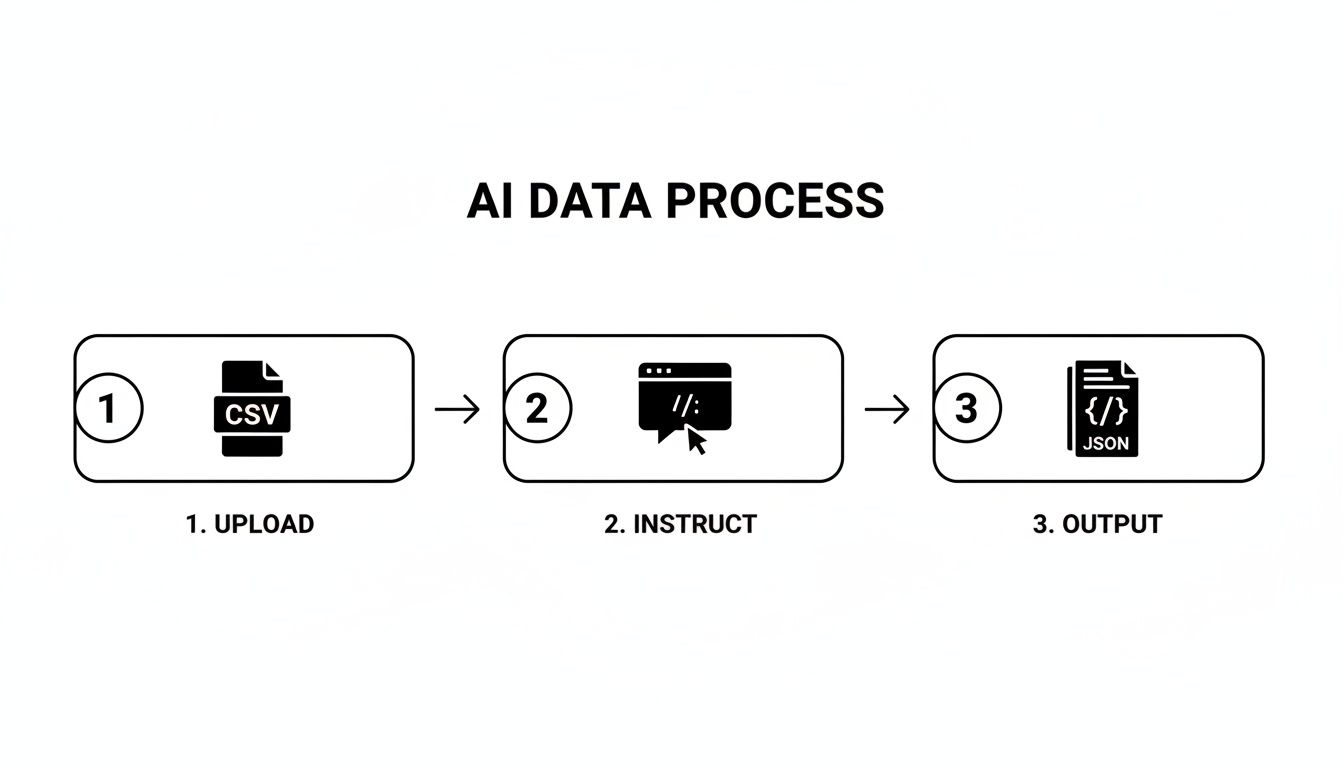
At its core, the whole game is translating your analytical logic into one crystal-clear instruction that an AI can run across thousands of rows without getting tired.
Stage 1: Prepare Your Data for Success
Every great AI project starts with your data. The goal is to get it into a simple format that an AI can process one row at a time. A clean, well-organized CSV file is the gold standard here.
Think of it like setting up your spreadsheet for a massive VLOOKUP. Each column is a specific piece of information, and each row is a complete record for the AI to work on. You need to clearly define what you already have (your inputs) and what you want the AI to create (your outputs).
For example, if you're analyzing competitors, you'd start with a CSV of the raw info you've gathered, then add empty columns for the AI to fill in.
Example CSV Schema For Competitor Analysis
A simple data structure like this gives the AI all the context it needs to work its magic.
| company_name | company_url | description_raw | target_audience (to be enriched) | key_features (to be enriched) | funding_stage (to be enriched) |
|---|---|---|---|---|---|
| Innovate Inc. | innovate.com | A B2B SaaS platform... | |||
| DataDriven Co | datadriven.co | Analytics software for... | |||
| NextGen AI | nextgenai.io | An AI-native solution for... |
This setup provides the AI with the source material in each row and a clear destination for its findings.
Stage 2: Design Your Instructions and Taxonomy
Once your data is ready, you need to tell the AI exactly what to do. This is where prompt design and taxonomy creation come in. Your prompt is the single, consistent instruction the AI will apply to every single row in your file. It's the most critical part of the process—it's how you inject your own expertise into the machine.
A solid prompt is specific, gives clear examples, and defines the exact output structure you expect. For instance, if you’re sorting customer feedback, you'd define your categories upfront.
- Sentiment:
Positive,Negative,Neutral - Key Theme:
Pricing,Customer Support,Product Feature,Onboarding - Urgency:
High,Medium,Low
By defining this taxonomy, you stop the AI from making up its own categories. This ensures you get clean, predictable data that actually aligns with your research goals.
Stage 3: Launch the Batch Enrichment Job
Now for the fun part: putting the AI to work. You upload your CSV, paste in your carefully crafted prompt, and kick off the batch job. This is where a platform like Row Sherpa really helps by running these jobs asynchronously. You don't have to babysit a progress bar or keep a browser tab open; you can go get a coffee or work on something else.
For deeper analysis, some tools let you enable a live web search for each row. This gives the AI permission to go out and pull fresh information from the internet to supplement the data in your CSV.
Imagine you're enriching a list of companies. With web search on, the AI can visit each company's website to find its target audience, key features, or latest funding round—info that wasn't in your original file. It turns a static list into a dynamic, data-rich asset.
This is a game-changer for demand-gen teams enriching lead lists or VC analysts screening hundreds of startups.
Stage 4: Validate and Analyze the Output
Once the job finishes, you'll get a notification to download your results. The output will be a perfectly structured file, either a new CSV with the enriched columns filled in or a JSON file. This is the moment the value of AI-powered market research hits home.
The final step is validation. No AI is perfect, so a quick spot-check of a few dozen rows is crucial to build confidence in the results. From there, you can load this clean, structured data directly into your favorite analysis tools—Tableau, a Python script, or just a pivot table in Excel—and get straight to finding insights. All the tedious grunt work is done, leaving you to focus on strategy.
Practical AI Use Cases For Your Role
Theory is one thing, but the real "aha!" moment comes when you see how AI-powered market research slots directly into your daily grind. Let's look at three real-world scenarios where AI takes a manual, soul-crushing bottleneck and turns it into a source of fast, usable insight.
Think of these as repeatable playbooks for tasks that eat up your week. A well-designed prompt can literally hand you back dozens of hours.
For The Market Research Analyst
You know the drill. You’ve got a CSV with 5,000 open-ended survey responses about a new feature. Reading, tagging, and summarizing that feedback manually would be a multi-day slog, and your consistency would inevitably drift by row 3,000. AI makes this a quick, fire-and-forget job.
Your goal here is simple: turn that wall of text into structured data you can actually pivot and chart.
- Input Data: A basic CSV with one column of raw customer feedback, like
feedback_text. - Prompt Example: "Analyze the following customer feedback. First, determine the overall sentiment and classify it as
Positive,Negative, orNeutral. Second, identify the primary theme from this list:UI/UX,Performance,Pricing, orMissing Feature. Third, extract the specific feature mentioned. Finally, provide a one-sentence summary of the user's core point. Return a JSON object." - Expected Output: The AI runs through every row and adds new, perfectly structured columns to your CSV:
sentiment,theme,feature_mentioned, andsummary.
What used to be a week-long project is now done in less than an hour. You can immediately build a chart showing that while UI/UX sentiment is 85% positive, feedback on Pricing is 60% negative. That's a sharp, data-backed insight you can take straight to the product team.
For The Demand Generation Specialist
A fresh list of 1,000 inbound leads from a webinar just landed on your desk. Right now, it's just names and emails. To qualify them, you need firmographic data and, more importantly, a hint of their actual buying intent. Doing this by hand means hours of tedious searching on LinkedIn and company websites.
With AI, you can automate this entire enrichment process, sending it out to search the web and bring back the data you need.
This isn't just about saving time; it's about adding a layer of intelligence to your lead scoring that was previously impossible at scale. You can move beyond basic firmographics and start qualifying leads based on real-time intent signals.
- Input Data: A CSV with
first_name,last_name, andcompany_domain. - Prompt Example: "Given the company domain, visit the website to find the following: company size (e.g.,
1-10,11-50), industry, and target audience (e.g.,B2B,B2C,B2G). Then, search for recent news or blog posts and determine if they have expressed buying intent for marketing automation software. Classify intent asHigh,Medium,Low, orNone. Return this information in a structured format." - Expected Output: Your original CSV comes back with valuable new columns filled in:
company_size,industry,target_audience, andbuying_intent.
Instead of a flat list, you now have a prioritized queue. You can instantly route all the High intent leads in the B2B software space directly to sales, cutting down the sales cycle and boosting conversion rates.
For The Venture Capital Analyst
Your firm is digging into the AI-native SaaS space, and you're staring down a pipeline of over 1,000 startups. Reading every website and pitch deck just to see if they fit your thesis is a monumental task. The risk of missing a hidden gem—or wasting days on a bad fit—is huge.
Here, you can use AI to apply your investment thesis as a consistent scoring rubric across the entire pipeline.
- Input Data: A CSV containing
company_name,company_url, andcompany_description. - Prompt Example: "You are a VC analyst. Our investment thesis is: 'We invest in seed-stage, AI-native B2B SaaS companies with a clear path to profitability and a founding team with deep domain expertise.' Based on the company's URL and description, score its alignment with our thesis from 1 (poor fit) to 10 (perfect fit). Identify any potential risks and flag if the founding team's background is mentioned on their site. Provide a brief rationale for your score."
- Expected Output: You get back a spreadsheet that’s now a powerful decision-making tool, with new columns for
thesis_alignment_score,identified_risks,founder_info_flag, andrationale.
With this structured output, you can filter for every company with a score of 8 or higher and instantly shrink your review list from 1,000 down to a manageable 50. You’ve just compressed weeks of initial screening into a single afternoon, freeing you up to do deep due diligence with the founders who matter most.
Choosing the Right AI Research Tools
<iframe width="100%" style="aspect-ratio: 16 / 9;" src="https://www.youtube.com/embed/TZe5UqlUg0c" frameborder="0" allow="autoplay; encrypted-media" allowfullscreen></iframe>Okay, you've seen the workflows and the real-world wins. The final step is picking a platform that can actually pull it off. But let's be honest: navigating the crowded market for AI-powered market research tools is a headache. Every vendor promises the world, but the right tool isn't about flashy demos. It's about having the core features to support the scalable, repeatable processes we've been talking about.
Your goal is to find something that plugs into your existing workflow, not a tool that forces you to reinvent the wheel. So, instead of getting lost in jargon, let's focus on a practical checklist of capabilities. This will help you make a smart decision, whether you're fighting for a budget or just trying to prove the concept with a free trial.
Your Core Feature Checklist
When you're evaluating options, look past the marketing hype and check under the hood. A serious platform is built for processing data at scale, not just for one-off creative tasks. The features below are non-negotiable if you're serious about automating your research.
- Asynchronous Processing: You absolutely need a "set it and forget it" system. The ability to launch a big job and have it run in the background is critical for productivity. You shouldn't be stuck watching a progress bar crawl across a 10,000-row file.
- Validated JSON/CSV Outputs: This is the whole point. The platform has to deliver structured, predictable data. It must return clean, validated files ready for immediate use in Excel or Tableau, with zero manual cleanup.
- Integrated Web Search: Raw data often isn't enough. A tool that can perform a live web search for each row in your dataset gives you a massive advantage. It's perfect for enriching leads, screening companies, or just getting fresh context.
- Robust API Access: Even if you don't write code, a well-documented API is a sign of a mature, serious platform. It opens the door to programmatic workflows and integrations with other systems, future-proofing your investment as you scale.
The best AI research tools are designed like industrial machinery—reliable, consistent, and built for heavy workloads. They prioritize structured output and scalability over the conversational fluff you'd find in a general-purpose chatbot.
Understanding Pricing and Scalability
Pricing models can be just as important as the features, especially when you’re just starting out. A lot of platforms are built for huge enterprise commitments, which can be a dealbreaker when you're just trying to prove the value on a smaller scale. You need a model that lets you grow.
A usage-based or pay-as-you-go plan is usually the best place to start. This model lets you run small test projects without a big upfront investment. You can process a few hundred rows to nail down your prompt and taxonomy, measure the ROI, and build a rock-solid case for scaling up. It takes the financial risk off the table and lets you show real results before asking for a bigger budget.
For more on this, you might be interested in our deep dive into the best AI tools for market research that offer this kind of flexibility.
Making Your Final Decision
At the end of the day, the right tool should feel like a natural extension of your analytical skills. It needs to handle the grunt work with precision, freeing you up to focus on strategy and interpretation. Before you commit to anything, run a pilot project using a free tier or a trial.
Take a real task—like categorizing a batch of survey feedback or enriching a small lead list—and run it through the platform from start to finish. This hands-on experience is the single best way to know if a tool will genuinely make your job easier. Your final choice should empower you to deliver sharper insights, faster, without adding a bunch of new complexity to your day.
Common Questions About AI Market Research
Stepping into AI-powered market research can feel like a big leap. It’s totally normal to have questions, especially with all the hype flying around. Let's cut through that noise and tackle the real-world concerns analysts like you bring up when looking at these new tools.
The goal here isn't to sell you on a fantasy. It's to give you straight, practical answers that build your confidence and bust a few myths along the way.
How Is This Different From Just Using ChatGPT?
This is the big one, and it's a fair question. You've probably used ChatGPT to brainstorm ideas or summarize articles, so why pay for a specialized platform? The difference comes down to three things that are non-negotiable for professional work: scale, consistency, and structured output.
Using a standard chatbot for market research is like trying to build a house with a Swiss Army knife. It's handy for a quick fix, but it’s absolutely the wrong tool for a large-scale project. You’ll slam into context limits, and the AI's "creativity" will make it drift, giving you inconsistent answers row after row.
Platforms designed for AI-powered market research are built for a completely different job. They’re designed for batch processing—applying one perfect, unchanging instruction to thousands of rows at a time.
- Scale: They chew through massive datasets without breaking a sweat, something a chatbot just can't do.
- Consistency: Every single row gets evaluated against the exact same logic. This kills the randomness and drift you fight with in a conversational model.
- Structured Output: They give you clean, validated JSON or CSV files. This is data that’s immediately ready for your favorite analysis tools, no cleanup required.
Think of it this way: one is a creative brainstorming partner, the other is a perfectly disciplined team of one thousand junior analysts executing your instructions flawlessly.
How Much Technical Skill Do I Need?
Another common worry is facing a steep, technical learning curve. The good news? Modern platforms are overwhelmingly no-code.
If you can write a clear email or a detailed project brief, you already have the skills you need to instruct an AI effectively. You don't need to know Python or understand the guts of a machine learning model.
Your expertise isn't in coding; it’s in market analysis, understanding customer intent, and knowing which questions to ask. The whole point of these tools is to let you translate that domain knowledge directly into a process that scales.
The core skill isn't technical—it's strategic. Your job is to craft a clear, unambiguous prompt that reflects your analytical goals. The platform handles all the complex plumbing behind the scenes.
You’re not building the engine. You’re just the driver telling it exactly where to go. This makes advanced AI accessible to anyone who can think logically and communicate clearly.
How Can I Trust The AI’s Accuracy?
Trust has to be earned. It's smart to be skeptical of an AI’s output. The key to building confidence in AI-powered market research is realizing it's a collaborative process, not a black box you just hope for the best with. You have more control than you think.
Getting to high accuracy comes down to a few core practices you can master in no time.
- Iterative Prompt Engineering: Your first prompt is almost never your best one. Start small. Grab a sample of 50 rows from your data and run the job. Look at the output. Where did the AI get confused or misinterpret you? Refine your prompt with clearer definitions, better examples, and a more rigid output structure, then run it again on your sample. This fast feedback loop is how you "train" the AI to give you exactly what you need.
- Building a Strong Taxonomy: Don't let the AI make up its own categories on the fly. If you're analyzing customer feedback, explicitly define the themes it should look for (e.g.,
Pricing,Onboarding,Bug Report). Providing a clear, predefined taxonomy forces the AI to color inside the lines you’ve drawn, which dramatically improves consistency and relevance. - Systematic Validation: Once your full batch job is done, don't just blindly trust the results. Do a spot-check. Randomly sample 1-2% of the output rows and quickly review them against the source data. This simple step gives you a gut check on the quality and helps you build a case for the AI's reliability when you present your findings.
At the end of the day, you are always in control. These tools are powerful amplifiers of your own expertise, not replacements for it. When you combine your analytical skills with these simple validation techniques, you can hit a level of accuracy and scale that manual methods just can't touch.
Ready to turn your tedious research tasks into a fast, scalable workflow? Row Sherpa gives you the power to categorize, enrich, and analyze thousands of rows of data in minutes, no code required. Start for free and run your first job today.