A Practical Guide to AI-Driven Market Research for the Modern Analyst
Discover how AI driven market research transforms your workflow. Learn practical techniques and tools to automate analysis and uncover deeper, faster insights.
Let’s be honest: the manual grind of market research is often the biggest bottleneck to delivering real insights.
If you’re a junior market research analyst, a demand-gen specialist, or a VC analyst, you've mastered the traditional methods—cleaning spreadsheets, endless categorizing, and sifting through mountains of unstructured data. You know the job, but you also know there has to be a smarter way to work, especially with AI and data sources progressing so rapidly.

This guide is for you. We'll explore how AI-driven market research doesn't replace your expertise but supercharges it, turning tedious, repeatable tasks into automated workflows that deliver insights with unbelievable speed.
Shifting from Manual Labor to Strategic Impact
Think of it like a skilled chef getting a state-of-the-art kitchen. Your strategic instincts are still essential, but new tools let you execute with incredible speed and scale. AI automation handles the most repetitive, mind-numbing parts of the job.
This fundamentally changes your role. Instead of spending 80% of your time on data prep and just 20% on analysis, AI flips that ratio. You get to focus on what actually matters: high-impact strategic thinking and telling compelling stories with data.
The goal isn't just to work faster; it's to elevate the quality and depth of your work. AI provides the leverage to move from being a data processor to a strategic advisor, delivering insights that drive critical business decisions.
The explosive growth of AI underscores this opportunity. The global artificial intelligence market is projected to hit USD 539.45 billion in 2026 and an incredible USD 3,497.26 billion by 2033. For market research teams, this means unprecedented access to powerful analysis tools. You can explore more about the AI market's growth and its implications on Grand View Research.
What This Transition Means for You
Adopting an AI-first mindset allows you to tackle projects that were previously impossible due to time or resource constraints. It means you can:
- Analyze entire datasets: Instead of relying on small, potentially biased samples, you can process every single piece of customer feedback.
- Maintain perfect consistency: An AI model applies the same logic to row one as it does to row 100,000, eliminating the human error and fatigue that creeps into manual work.
- Accelerate your workflow: What once took a week of spreadsheet drudgery can now be done in minutes, drastically shortening the time from data to insight.
This guide will walk you through the practical applications, showing you exactly how to build a smarter, more efficient research process.
Understanding the Core AI Research Techniques
So, how does AI-driven market research actually work? It’s not about getting a Ph.D. in complex algorithms. Instead, think of it as a set of powerful tools that automate and accelerate the kind of analytical work you're already doing. These technologies are the engine turning raw, messy data into structured, actionable insights.
At its heart, AI-driven market research relies on a few key techniques to do the heavy lifting. Each one is designed to tackle a specific—and often painful—part of the traditional research workflow, from making sense of customer reviews to finding hidden market segments.
Let's look at how common research tasks are transformed.
Traditional vs AI Driven Market Research Tasks
For a junior analyst, the difference isn't just about speed; it's about shifting focus from manual drudgery to strategic thinking. This table shows the "before and after" picture for a few common tasks you're likely familiar with.
| Market Research Task | Traditional Manual Approach (The Grind) | AI Driven Approach (The Smart Way) |
|---|---|---|
| Sentiment Analysis | Reading hundreds of reviews and manually tagging each as 'Positive', 'Negative', or 'Neutral'. | AI instantly classifies sentiment across 10,000+ reviews, providing consistent, quantifiable results. |
| Theme Extraction | Highlighting keywords and creating a tally sheet to find recurring topics in open-ended survey answers. | AI automatically identifies and clusters themes like 'shipping delays' or 'poor UI' from thousands of text fields. |
| Data Categorization | Sorting customer support tickets into categories like 'Bug Report' or 'Feature Request' one by one. | An AI classifier learns your rules and automatically assigns the correct category to every ticket in minutes. |
| Persona Discovery | Sifting through customer data, trying to spot patterns and manually group users into rough segments. | AI analyzes behavior and feedback to reveal data-backed customer segments you never knew existed. |
The goal isn't to replace the analyst, but to give them superpowers. By automating the grind, AI frees up your time for the work that really matters: interpreting the results and shaping business strategy.
Natural Language Processing: The Ultimate Text Analyzer
Imagine you’ve been asked to read, understand, and categorize ten thousand customer reviews. Manually, that's a nightmare. This is where Natural Language Processing (NLP) steps in.
Think of NLP as the AI's ability to comprehend human language—both text and speech—at an enormous scale. It’s the engine that powers sentiment analysis, theme extraction, and even spotting specific product mentions in reviews.
Instead of you spending a week manually tagging a review as "positive" or "negative," an NLP model does it instantly and with incredible consistency. It can pull out recurring topics like ‘shipping delays’ or ‘excellent customer service’ across thousands of survey responses, turning qualitative feedback into hard numbers.
This is what it looks like in a modern, prompt-based AI platform.
You just upload a file and write a plain-English instruction. The AI handles the complexity of processing thousands of rows, turning what used to be a complex project into a simple command.
Machine Learning Classifiers: The Smart Sorter
You've got a massive spreadsheet of user feedback, and your manager wants it sorted into neat categories like 'Pricing Issue,' 'Feature Request,' or 'Bug Report.' Doing this by hand is not just tedious; it's also prone to human error. This is a perfect job for machine learning (ML) classifiers.
An ML classifier acts like an infinitely patient and consistent intern. You give it a few examples or a clear set of rules (often in a simple prompt), and it learns to automatically assign the correct category to every single row in your dataset.
- Consistency: The classifier applies the exact same logic to row 50,000 as it did to row one, removing human fatigue and subjectivity.
- Speed: It can categorize tens of thousands of entries in the time it takes you to grab a coffee.
- Scalability: It works just as well on a million rows as it does on a hundred.
This kind of automation is a game-changer for building a structured taxonomy out of messy, unstructured data. If you want to dig deeper into how this works in practice, you can explore more applications in our guide on using AI for data analysis.
Clustering Algorithms: Finding Hidden Patterns
Sometimes, the most valuable insights are the ones you weren't even looking for. Clustering algorithms are built for this exact kind of discovery. They sift through your dataset and automatically group similar data points together based on their shared characteristics.
For example, imagine you have data on thousands of customers, including their purchase history, website activity, and feedback. A clustering algorithm might find three distinct groups you never knew existed:
- "High-Value Power Users" who buy premium products and constantly engage with new features.
- "Occasional Bargain Hunters" who only purchase during sales events.
- "Support-Heavy Newcomers" who seem to be struggling with the initial onboarding process.
These automatically generated segments give you a powerful new lens to see your market through. Instead of starting with assumptions, you let the data reveal the natural groupings within your audience. This transforms a flat customer list into a rich map of distinct personas, leading to much more targeted and effective strategies.
Building Your AI-Powered Research Workflow
Alright, let's move from theory to practice. This is where AI-driven market research really starts to click. We're not talking about abstract ideas anymore; we're talking about building a repeatable, automated system that turns raw data into a strategic asset. Getting this workflow right is the secret to unlocking speed, scale, and consistency in your projects.
An AI-powered workflow really boils down to a clear, four-stage process. Each step feeds into the next, creating a powerful engine that transforms messy inputs into clean, analysis-ready outputs. The best part? Modern no-code platforms make this entire sequence accessible, even if you don't have a technical background.
This is what that high-level process looks like, showing how raw data moves through the AI to become something you can actually use.
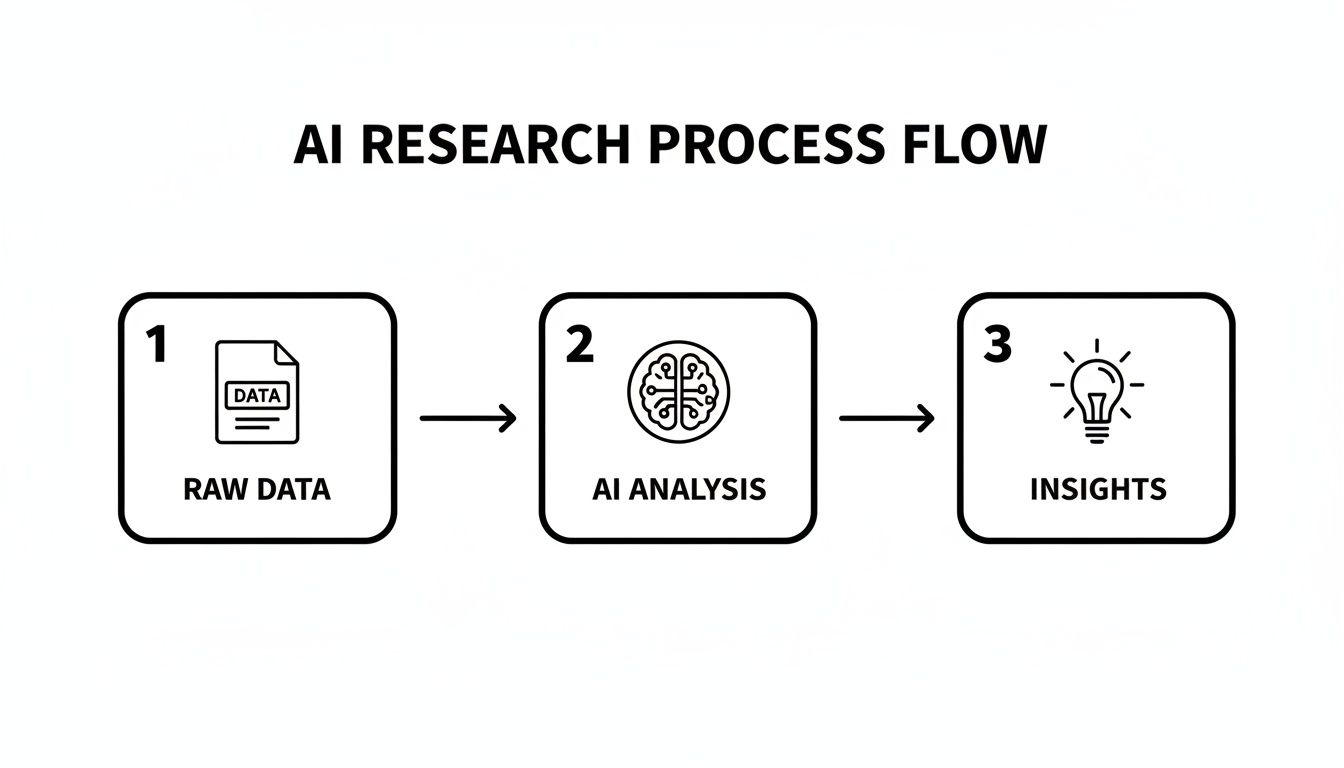
This flow represents a fundamental shift. Instead of slogging through manual processing, you have an automated, scalable system where the AI does the heavy lifting. Now, let's break down each of these stages.
Stage 1: Sourcing Your Data
Every great research project starts with the right ingredients. Your source data is the foundation for everything that follows, and its quality will absolutely dictate your final results. It’s the classic "garbage in, garbage out" principle.
This initial data can come from all the places you're probably already using:
- Internal Systems: Think raw data exports from your CRM, customer support platforms, or internal databases.
- External Feeds: This could be web scrapes of competitor sites, lists from trade shows, or data from third-party providers.
- Direct Feedback: This covers everything from open-ended survey responses and customer interview transcripts to online reviews.
The goal here is simple: gather your inputs and get them into a structured format, like a CSV file, so they’re ready for the next step.
Stage 2: Enriching for Context
Raw data is just a starting point; it often lacks the context you need to do any real analysis. This is where AI-powered enrichment becomes a total game-changer. Forget spending days manually searching for missing information—you can automate it.
Imagine a VC analyst with a list of 5,000 startups—just a name and a URL. An AI workflow can automatically visit each website and fill in the blanks with crucial data points like:
- Industry and Sector: What market does this company actually play in?
- Funding Stage: Has it raised a Seed, Series A, or is it further along?
- Business Model: Is it B2B, B2C, SaaS, or a marketplace?
Suddenly, a simple list becomes a rich dataset, ready to be screened against an investment thesis.
Stage 3: Automating Taxonomy
Creating a consistent taxonomy—or a classification system—is one of the most painfully time-consuming manual tasks in market research. It’s also where human error and inconsistency love to creep in and ruin your data quality.
AI automation crushes this problem by applying a single, precise instruction to every single row in your dataset. You define the categories once in a simple prompt, and the AI executes it flawlessly across thousands of records.
For a demand-gen specialist, this might mean categorizing 10,000 inbound leads into tiers based on their website's content. For a market researcher, it could mean classifying thousands of support tickets into themes like 'Billing Issue,' 'Feature Request,' or 'Usability Problem.' This step ensures every piece of data is neatly organized and ready for quantitative analysis.
If you want to see how this works in practice, check out our guide on building a batch process for your CSV files with LLMs.
Stage 4: Validating Your Output
The final stage is all about making sure the data you've just processed is clean, reliable, and ready for your favorite analysis tool, whether that's Tableau, Power BI, or just a good old-fashioned pivot table in Excel.
A truly robust AI platform won't just spit out data; it will guarantee a structured output. This means the results are delivered in a predictable format—like a validated JSON or a clean CSV—that can be easily imported into other systems. Your job, as the analyst, is to do a final spot-check. You use your expertise to confirm the AI's output aligns with your strategic goals before you move on to visualization and reporting.
Putting AI Research into Practice with Real Examples
Theory is one thing, but seeing AI-driven market research in action is where the real confidence comes from. Let's get past the concepts and dive into concrete use cases that solve the repetitive, time-sucking tasks you’re already doing. Think of these as mini-playbooks showing how you can save dozens of hours while actually improving the quality of your work.
This isn’t some future-forward trend; it's a massive shift happening right now. The corporate world is catching on fast. Recent data shows AI adoption shot up to 72% in 2025, a huge leap from the steady 50% range we saw between 2020 and 2023. If you want to dig into the numbers behind this move, Intuition.com has a great breakdown.
For the VC Analyst Screening 5,000 Startups
Your investment thesis is sharp, but your deal flow is a firehose—often just a list of company names and URLs. The old way means weeks of mind-numbing manual work, visiting each site just to see if a startup is even worth a first look.
An AI-powered workflow completely changes the game. You simply upload your list of 5,000 startups and tell the AI to act as your junior analyst.
Example Prompt: "For each company URL, visit the website and extract the following: 1) Core business model (B2B SaaS, B2C Marketplace, etc.), 2) Target industry (FinTech, HealthTech, etc.), and 3) Identify key value propositions from the homepage. Classify each company as 'Aligns with Thesis' or 'Does Not Align' based on our focus on B2B FinTech."
In less than an hour, you have a perfectly structured spreadsheet. The initial screening is done. Now you can spend your time where it counts: deep-diving into the 200 or so companies that actually fit your criteria.
For the Demand-Gen Marketer Enriching Trade Show Leads
You’re back from a conference with 1,000 raw leads—names, emails, maybe a company name if you’re lucky. Before you can even think about a nurture campaign, they need to be qualified and segmented. Doing that by hand is a total non-starter.
With AI, this becomes a simple, automated job.
- Step 1: Enrichment. Kick off an AI workflow that visits each lead's company website. It automatically pulls in firmographic data like company size, industry, and location, enriching your raw list.
- Step 2: Scoring. Next, you run a scoring model with another instruction. The AI analyzes the new data and website content, assigning a lead score from 1-100 based on your ideal customer profile (ICP).
- Step 3: Segmentation. Finally, the AI segments the whole list into clear, actionable tiers: ‘High-Priority,’ ‘Nurture,’ and ‘Low-Priority.’
A data cleanup project that used to take a week is now done in 15 minutes. Your sales team gets a clean, prioritized list, and you can launch targeted campaigns immediately.
For the Market Researcher Analyzing Survey Comments
You just closed a survey with 10,000 open-ended comments. It's a goldmine of qualitative feedback, but manually reading, tagging, and quantifying it all is a monumental task—slow, subjective, and prone to inconsistency.
This is a perfect job for AI-driven market research. You can process the entire dataset in minutes by running a sequence of AI tasks.
- Sentiment Analysis: First, get a high-level emotional pulse by classifying every comment as 'Positive,' 'Negative,' or 'Neutral.'
- Theme Extraction: Next, tell the AI to identify and pull out recurring themes. It will quickly surface topics like "poor customer support," "easy onboarding," or "requests for new integration."
- Root Cause Identification: For the final step, ask the AI to dig deeper and pinpoint the likely root cause behind negative comments for each theme.
The output is a structured dataset that puts hard numbers on what was once purely qualitative. You can build charts showing that 35% of negative comments are tied to pricing, giving stakeholders clear, data-backed insights they can act on.
How to Measure Your Success and Prove ROI
<iframe width="100%" style="aspect-ratio: 16 / 9;" src="https://www.youtube.com/embed/ZI2XuOfZ5iU" frameborder="0" allow="autoplay; encrypted-media" allowfullscreen></iframe>Let's be real: adopting any new tool, especially one involving AI, means you need a rock-solid business case. To get your manager’s buy-in, vague promises of "efficiency" just won't cut it. You need to show them the money.
The good news is that the value of automating tedious research tasks is incredibly easy to prove. You just have to shift the conversation from the cost of the tool to the tangible value it creates. Instead of talking in abstracts, you can point to hard numbers that tie directly to your team’s output and project wins.
From Hours to Minutes
The most direct and undeniable metric is time saved. Think about those brutal 40-hour data cleaning sessions that consume an entire week. That's your baseline.
Now, do the math. If manually categorizing 5,000 survey responses took you 40 hours, and a well-tuned AI workflow nails it in 15 minutes, you’ve just clawed back 99.6% of your time. This isn't just an incremental gain; it's a complete game-changer for your team's capacity.
Simple Formula: (Time for Manual Task - Time for AI Task) = Hours Saved
When you present this, it’s not a guess, it's a fact: "This tool gives me back 39 hours on every project. I can spend that time on deep analysis instead of mind-numbing data prep."
From Sample Size to Full Coverage
Traditional research always has a ceiling. You're forced to work with small samples—maybe analyzing 1,000 rows from a 100,000-row dataset—because that's all you can manually handle. This introduces a huge risk: sampling bias. What crucial insights are hiding in the 99% of data you never even saw?
AI completely shatters that ceiling.
- Before AI: You analyze a 1% sample and cross your fingers that it's representative.
- After AI: You analyze 100% of the dataset, making sure every single voice is heard.
This is a massive win for data integrity. You can stand behind your findings with full confidence, knowing they’re based on the complete picture, not just a tiny, potentially skewed, slice of it.
Perfect Consistency and Accuracy
Another huge pain point is data quality. When a human is manually tagging thousands of rows, fatigue kicks in. Subjectivity creeps in. Mistakes happen. An AI model, on the other hand, applies the exact same logic, flawlessly, from the first row to the very last.
You can actually measure this. Take a sample of manually categorized data and compare it to what the AI produces. For most classification tasks, AI can hit near-perfect accuracy while completely eliminating the human inconsistency that makes data unreliable. Your analysis is suddenly built on a foundation of clean, consistent, and trustworthy information.
From Weeks to Days
Finally, look at your speed to insight. Right now, how long does it take your team to get from a mountain of raw data to a finished report? If the answer is "weeks," AI can shrink that timeline to days.
By automating the most grueling front-end work—cleaning, enrichment, and categorization—you radically shorten the entire project lifecycle. This means your team can deliver critical market intelligence while it's still fresh and relevant, not weeks after the conversation has already moved on. That kind of speed isn't just a nice-to-have; it's a real competitive advantage.
Any powerful tool needs a skilled operator, and AI-driven market research is no different. You can't just hit a button and hope for magic; the real value comes from knowing how to guide the process and critically evaluate what comes out the other side.
Getting a handle on the potential challenges is the first step toward using AI responsibly and, more importantly, effectively.
The most critical rule is a tale as old as data itself: "garbage in, garbage out." An AI model is only as good as the data it’s trained on. If you feed it messy, inconsistent, or incomplete data, you’ll get messy, inconsistent, and incomplete insights back. It's that simple. Making sure your source data is as clean and well-structured as possible isn't just a suggestion—it's non-negotiable.
This one step sets the stage for a successful project and drastically cuts the risk of generating junk from the get-go.
The Analyst Is the Essential Human in the Loop
While AI is great at automating the heavy lifting, it's your analytical judgment that makes the technology truly powerful. You are the essential human-in-the-loop—the person who guides the process, interprets the results, and makes sure the final insights are sound, reliable, and actually mean something for your strategy.
Think of yourself as the pilot, not a passenger. The AI is your advanced navigation system, but you’re the one setting the destination, monitoring the instruments, and making the final call. That oversight is absolutely crucial for catching subtle errors or contextual misunderstandings that an algorithm is almost guaranteed to miss.
Your expertise is the safeguard that turns automated output into trusted intelligence. The goal is to augment your skills, not abdicate your responsibility for the final analysis.
Avoiding Algorithmic Bias
Another place where human oversight is critical is with algorithmic bias. AI models learn from the data we give them. If that data reflects existing societal or historical biases, the AI will learn those biases and amplify them. This can lead to skewed conclusions that completely misrepresent certain demographics or market segments.
To head this off, you have to be proactive:
- Audit your source data: Actively hunt for and correct imbalances in your datasets before you even start processing.
- Question the output: Always ask if the results make sense. If an insight seems a little too convenient or reinforces old stereotypes, it's time to dig deeper.
- Use your gut: Your industry knowledge is a powerful tool. Use it to spot-check AI-generated categories or sentiments that just feel off.
Your job is to make sure the AI's logic aligns with a fair and accurate view of the world. For a deeper dive into responsible data handling, you can check out our guide to market research best practices for more structured approaches.
Ultimately, navigating these pitfalls comes down to a partnership. The AI provides the scale and speed; you provide the critical thinking, context, and ethical guardrails. That collaboration is the key to unlocking what AI-driven market research can really do.
Your AI Market Research Questions Answered
Moving to an AI-first workflow always brings up a few practical questions. You know your job inside and out, but figuring out how a new tool fits into your day-to-day can feel like a big hurdle.
Here are some straightforward answers to the questions we hear most from analysts just getting started with AI-driven market research.
Do I Need to Know How to Code to Use AI for Market Research?
Absolutely not. The newest generation of AI tools was built specifically for business users, not programmers.
Modern platforms give you a simple, no-code interface where you can upload a spreadsheet, write a prompt in plain English, and run complex data jobs without touching a single line of code. The focus has shifted completely to your analytical skills—it’s about what you want to accomplish, not how you can technically manipulate the data. This means you can start getting value from day one.
How Can I Trust the Accuracy of AI-Generated Data?
Trust isn’t about blindly accepting what the AI gives you. It’s built through a process of control and validation, and your expertise is the most important part of it.
Think of it as a three-step process:
- Start Clean: First, always begin with the cleanest, most reliable source data you can get. The old "garbage in, garbage out" rule is more important than ever with AI.
- Ensure Consistency: Use tools that apply the exact same logic to every single row, every single time. This gets rid of the human error and fatigue that creep into manual data cleaning.
- You Validate the Output: Finally, you are always the expert who spot-checks the results. The AI does the heavy lifting, but your expertise provides the final seal of approval.
Is AI Actually Good for Analyzing Qualitative Data?
Yes—in fact, this is one of its biggest strengths. AI, especially models built on Natural Language Processing (NLP), is incredible at understanding and structuring messy, open-ended text at a scale no human ever could.
For instance, NLP can run sentiment analysis across thousands of customer reviews, pull out key themes from survey responses, and pinpoint specific names or product features mentioned in feedback. It turns a mountain of unstructured qualitative text into structured, quantitative data you can actually analyze.
What Is the Best Way to Start with a Small Budget?
Start small and prove the value. Pick one highly specific, painful task that eats up your team's time.
Many platforms, including ours, offer free or low-cost starter plans that let you process a few thousand rows a month—perfect for a pilot project. You could try categorizing a week's worth of support tickets or enriching a small lead list from a recent conference.
By automating just one process, you can show a clear ROI in hours saved and better data quality. That builds a data-backed case for a bigger investment later on.
Ready to stop the data grind and start delivering insights faster? Row Sherpa gives you the power to automate your most repetitive research tasks. Sign up for a free plan and process your first file in minutes.